Hyperstack Alternative: Lighter Credential Issuance for Smaller Programs
Hyperstack is built for institutions. Badges Ninja gives smaller training programs the same Open Badge output without the institutional overhead.
 By Nacho Coll
 Nacho founded Badges Ninja to make issuing verifiable digital credentials as simple as a single API call — Open Badge v2.0 badges and certificates, minted, hosted, and verifiable without standing up your own issuer infrastructure.
If you’ve been searching for a Hyperstack alternative, you’re probably in one of two situations: either you got a quote from Hyperstack and the price made you wince, or you explored the platform and realized it was built for something bigger than what you actually need. Both are legitimate reasons to keep looking.
Hyperstack is genuinely good at what it does — institutional credentialing at scale, with deep analytics and integrations. The problem is that institutional-grade architecture tends to come with institutional-grade overhead: onboarding complexity, pricing tiers priced for procurement departments, and feature depth that most training-team leads will never touch.
This comparison is for the other group: program owners at training companies, professional associations, online course platforms, and L&D teams who need to issue verifiable Open Badges without the infrastructure overhead. We’ll look at where Hyperstack earns its price tag and where https://badges.ninja covers the same ground for a fraction of the cost — plus the honest moment when you should consider outgrowing Badges Ninja.
What Hyperstack Is Built For
Hyperstack targets universities, large training institutions, and enterprise L&D departments. Its strength lies in three areas:
Institutional integrations. Hyperstack connects with major LMS platforms, HRIS systems, and identity providers. If your organization runs Workday for HR and Canvas for learning, Hyperstack can pull completion data from both and trigger credential issuance automatically. That kind of end-to-end wiring is valuable when you have dozens of systems talking to each other.
Analytics dashboards. Hyperstack gives program managers detailed reporting on issuance volume, recipient engagement, verification rates, and LinkedIn share activity across the whole credential catalog. If a VP wants a quarterly credential report broken down by department or program, Hyperstack can generate that.
White-label and institutional branding. Large organizations that need the credential portal to look and feel like their own platform — not a third-party tool — get that option with Hyperstack.
These are real features solving real problems. If your credentialing program sits inside an institution that already has procurement, IT governance, and multi-department coordination requirements, Hyperstack’s offering starts to make sense.
The challenge is that those features cost money. Hyperstack pricing is not publicly published (a tell, in itself), but organizations report starting costs well above what smaller programs budget for credentialing tools — often in the range of per-seat or per-volume contracts negotiated with sales.
What Badges Ninja Does Differently
https://badges.ninja is designed around a different premise: that issuing a verifiable Open Badge v2.0 credential should take minutes, not a procurement cycle.
The platform is fully self-serve. You sign up, verify your email, register an issuer, build a badge in the visual designer, and issue your first credential — all in a single session. No demo required, no onboarding call, no waiting for IT to provision access.
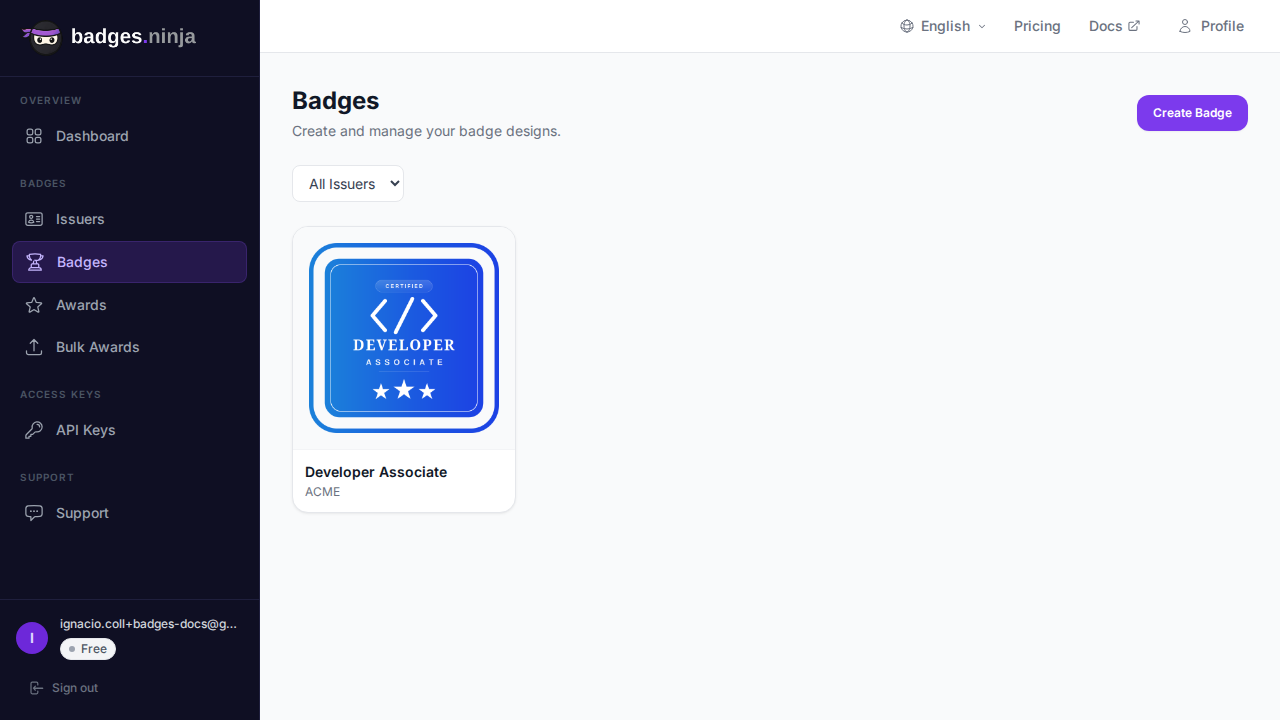
Here’s what smaller programs actually use day-to-day:
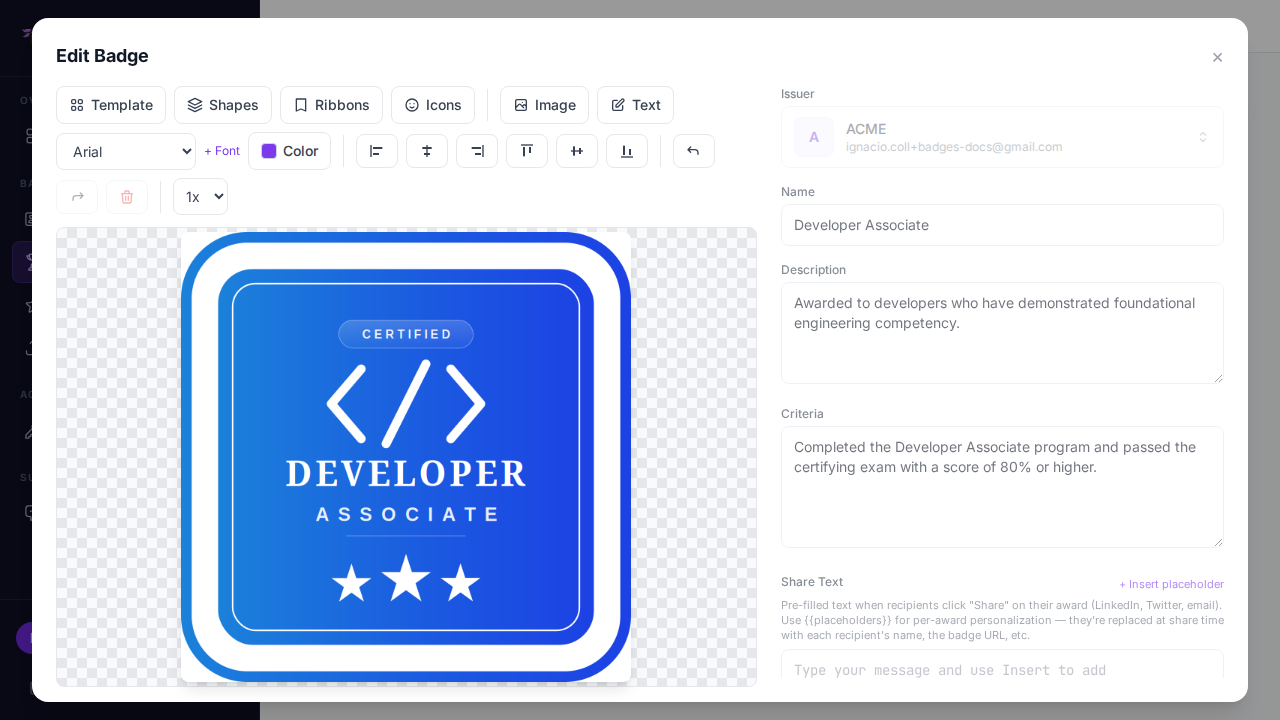
The visual badge designer. Over 80 pre-built templates, customizable shapes, 50+ icons, 11 fonts, and custom background upload. Snap-to-grid alignment and multi-select make it possible to design a professional badge in 15 minutes without a designer on call. Hyperstack does not have an equivalent in-platform design tool — most issuers on enterprise platforms build badge images externally and upload them.
Bulk credentials via CSV. Upload a CSV with name, email, and optional issue date. The platform processes the batch, sends recipient notifications, and stores each credential with a unique verification URL. You can pause and resume mid-batch if something goes wrong — the server holds state even if you close the browser tab.
The recipient portal. Every recipient gets access to https://badges.ninja/me via magic-link (no password required). They see all their badges, can download the PDF certificate, share to LinkedIn with one click, or grab the verification URL. Their public profile at badges.ninja/u/{handle} is permanently accessible without login.
Open Badge v2.0 compliance. Every credential is backed by a full JSON-LD assertion at a public URL. Verifiers, recruiters, and credentialing bodies can hit that URL directly — no account, no third-party dependency. This is the same technical standard Hyperstack outputs.
Plans that start at $0. The free tier covers 1,200 credentials per year with full feature access. Starter is $9/month. Pro is $29/month. There is no sales call at any tier.
Side-by-Side Comparison
| Badges Ninja | Hyperstack | |
|---|---|---|
| Starting price | $0 (free tier, 1,200 credentials/yr) | Custom contract, not published |
| Self-serve signup | Yes, instant | No, requires sales contact |
| Visual badge designer | Yes (80+ templates, in-platform) | No (external image upload) |
| Open Badge v2.0 output | Yes | Yes |
| Recipient portal | Yes (magic-link, no password) | Yes |
| LinkedIn Add-to-Profile | Yes | Yes |
| PDF certificate | Yes, per credential | Varies by plan |
| Bulk CSV issuance | Yes, pause/resume | Yes |
| LMS integrations (native) | API + webhooks | Deep native connectors |
| Analytics dashboards | Basic (volume + share stats) | Advanced (cross-program reporting) |
| White-label portal | No | Yes |
| HRIS integration | API | Native |
| Enterprise SSO | No | Yes |
The table tells you most of what you need to know. Hyperstack wins on the institutional column: deep integrations, advanced analytics, white-label, SSO. Badges Ninja wins on the accessibility column: price, speed-to-issue, and the visual designer.
Comparison by Program Size
Volume is the clearest decision factor here.
Under 1,000 credentials per year. At this scale, the overhead of Hyperstack is hard to justify. You don’t need cross-program analytics or HRIS triggers. What you need is to issue a professional-looking credential, have recipients share it to LinkedIn, and not think about it again until the next cohort. Badges Ninja handles this at $0–$9/month, with no setup friction.
1,000–5,000 credentials per year. This is the range where it’s worth doing a real comparison. If your program is self-contained — one team, one platform, one workflow — Badges Ninja’s API and bulk-credentials flow scales well here. If you’re coordinating across multiple departments, programs, or systems that need to talk to each other automatically, Hyperstack’s integration layer starts to earn its cost.
Over 5,000 credentials per year. If you’re here, and especially if you have multi-department or multi-program needs, Hyperstack is worth a serious look. The analytics visibility alone becomes meaningful at this volume, and the IT governance requirements that come with large-institution credentialing make the native SSO and white-label options valuable.
A note on the free tier math. If you run a small nonprofit, a conference, or an online course platform with modest volumes, 1,200 credentials per year on the free tier may cover your entire program. That’s 1,200 verifiable, LinkedIn-shareable credentials per year at zero cost — and because it’s a flexible annual pool with no monthly ceiling, you can issue them steadily or all at once when an event or cohort wraps. No equivalent exists on Hyperstack.
Getting Started Without an Onboarding Call
One underappreciated difference between these platforms is time-to-first-badge. With Hyperstack, the path to issuing your first credential runs through a sales conversation, a demo, provisioning, and onboarding. For a program manager who just wants to know if the platform fits their needs, that’s a significant commitment upfront.
With Badges Ninja, you can issue a real credential — to a real email address, with a real public verification URL — in the time it takes to complete an onboarding form and open the designer. That exploratory capability matters when you’re evaluating tools. You learn more from a live badge than from a product tour.
The getting started guide at https://badges.ninja/docs/getting-started walks through the full issuer → badge → credential flow in detail.
When Badges Ninja Is the Wrong Call
This comparison is only useful if it’s honest, so here are the situations where you should stay with Hyperstack or look at institutional platforms:
You need HRIS-triggered issuance. If your credentialing is tied to events that live in Workday, SAP SuccessFactors, or similar HR systems, Hyperstack’s native connectors remove significant engineering work. Badges Ninja has an API, but you’d need to build the integration yourself.
You need SSO across the whole organization. If your IT team requires all tools to authenticate through a central identity provider, Hyperstack supports this. Badges Ninja does not currently offer enterprise SSO.
You need cross-program analytics for leadership. If a VP of Learning needs to see credential issuance, engagement, and verification rates across ten programs in a single dashboard, Hyperstack’s reporting layer is built for that. Badges Ninja shows per-badge statistics (credentials issued, shares, verifications), but not an aggregated executive-layer view.
You’re white-labeling for clients. If you’re an L&D agency issuing on behalf of client organizations and need the portal to be fully unbranded, Hyperstack supports that. Badges Ninja’s recipient portal is branded.
None of these are reasons to avoid Badges Ninja if they don’t apply to you — they’re reasons to recognize when institutional infrastructure starts paying for itself.
When You’ll Outgrow Badges Ninja
Being honest: Badges Ninja is built for programs with focused needs, not for enterprise credentialing operations. Here are the signals that you’ve grown past it:
- You’re issuing across more than five distinct badge programs and need aggregated reporting to manage them
- Your compliance or legal team requires data residency in a specific region
- Your IT governance requires vendor security assessments and enterprise contracts
- You need native integrations with multiple internal systems without building custom API bridges
- You’re white-labeling credentials for client organizations who need their brand, not yours
If you’re at that scale, the cost of Hyperstack (or Accredible, or a similar institutional platform) becomes justified because the alternative is engineering time to replicate what they ship out of the box. See ./accredible-alternative for a similar comparison if you’re also evaluating that option.
The Practical Migration Story
If you’re coming from Hyperstack and want to move smaller, the path is straightforward. Open Badges are portable by design — the credential data lives in a JSON-LD assertion at a public URL, not inside any vendor’s database. Existing issued badges remain valid and accessible even after you switch platforms. You can re-issue going-forward on Badges Ninja while old badges remain verifiable on their original URLs.
For your recipients, the experience is nearly identical: they still have a public verification URL, a LinkedIn Add-to-Profile button, and a PDF certificate. The main visible change is the issuer profile URL format and the badge designer output if you’re redesigning templates.
If you’re looking for a full cost breakdown of the Open Badges platform landscape before committing to any tool, ./cheapest-open-badges-platform-2026 has the side-by-side pricing table you want.
The Bottom Line
Hyperstack is a capable institutional platform doing what institutional platforms do: deep integrations, advanced analytics, white-label options, and the operational overhead that comes with enterprise tools. If your credentialing program lives inside an institution with those requirements, it’s worth the cost.
If you’re running a training company, a professional association, an online course platform, or an L&D team that wants to issue verifiable Open Badges without a procurement cycle, https://badges.ninja covers the same core output — Open Badge v2.0 credentials, recipient portal, LinkedIn sharing, PDF certificates — at a fraction of the price, starting the day you sign up.
The question isn’t which platform is better in the abstract. It’s which one fits what you’re actually building right now.
Ready to issue your first verifiable credential? Start free at badges.ninja — visual designer, public verification page, PDF certificate, Open Badge v2.0 output. No credit card required.
About the author
Nacho Coll
Founder & Engineer at Badges Ninja
Nacho founded Badges Ninja to make issuing verifiable digital credentials as simple as a single API call — Open Badge v2.0 badges and certificates, minted, hosted, and verifiable without standing up your own issuer infrastructure. Writes about the Open Badges spec, credential verification, and running a credentialing platform serverless on AWS, from the operator side of the wire.