
Credly vs Accredible: Which Enterprise Credential Platform Wins?
An honest Credly vs Accredible comparison on price, design, analytics, and integrations — plus the lower-cost alternative most smaller issuers actually need.
 By Nacho Coll
 Nacho founded Badges Ninja to make issuing verifiable digital credentials as simple as a single API call — Open Badge v2.0 badges and certificates, minted, hosted, and verifiable without standing up your own issuer infrastructure.
If you’ve been asked to “pick a credentialing platform” for a university, certification body, or corporate training program, you’ve probably narrowed the enterprise shortlist down to two names: Credly and Accredible. Both have been issuing digital credentials for over a decade, both count large institutions as customers, and both show up in the same procurement conversations. That overlap is exactly why the comparison is confusing — on paper they look similar, but the platforms optimize for different things.
Credly built its reputation on network effects: a shared recipient ecosystem, a deep partnership with LinkedIn, and integrations into the HR and talent-marketplace tools that large employers already use. Accredible built its reputation on the opposite end of the workflow: white-labeled recipient experiences, detailed analytics, and LMS integrations that let universities and training companies keep their own brand front and center.
Neither platform publishes public pricing, and both require a sales conversation before you see a real quote. That alone should tell you something: these are enterprise tools built for organizations issuing thousands of credentials a year, not a quick way to issue fifty certificates for a Tuesday workshop. We’ll compare them honestly here, then talk about the (much larger) group of issuers for whom neither one is actually the right fit.
Credly vs Accredible at a Glance
| Credly | Accredible | |
|---|---|---|
| Core strength | Recipient network effects, LinkedIn partnership, talent-marketplace integrations | White-label branding, detailed analytics, LMS connectors |
| Pricing model | Enterprise, sales-led, custom quote (no public pricing) | Enterprise, sales-led, custom quote (no public pricing) |
| Typical customer | Certification bodies, professional associations, large employers | Universities, bootcamps, large training companies |
| Recipient experience | Centralized Credly-branded profile shared across all issuers on the platform | Fully white-labeled — recipients often never see the Accredible name |
| Design flexibility | Professional templates, customization within Credly’s framework | Template-based design with more layout and branding control |
| Analytics | Credential engagement tracking, standard reporting | Detailed geographic, demographic, and LinkedIn-add reporting |
| LMS integrations | Available, but the platform’s core value is the recipient network | Pre-built connectors for Moodle, Canvas, Blackboard, and others |
| Open Badge compliance | Yes, with Credly platform extensions | Yes, standards-based output |
| Minimum realistic spend | Enterprise contract, typically well into five figures annually | Enterprise contract, typically starting in the hundreds per month and scaling with volume |
Both platforms are credible (no pun intended) choices for large-scale, well-funded credentialing programs. The differences below determine which one actually fits your organization.
Where Credly Wins
Credly’s biggest advantage isn’t a feature — it’s the recipient network itself. When someone earns a Credly-issued badge, it lands in a profile that’s shared across every other organization issuing on Credly. That means recruiters and hiring managers who already use Credly’s talent-marketplace tools can discover your recipients directly, and your recipients benefit from a badge ecosystem that’s bigger than just your program.
That network effect comes with real integrations: a long-standing LinkedIn partnership for adding credentials to a profile, connections into applicant-tracking and talent-marketplace platforms, and enterprise SSO/directory support (SAML, OIDC, Active Directory) for large IT organizations. If your program’s success depends on employers actively searching for people who hold your credential, Credly’s network is hard to replicate.
The trade-off is design and brand control. Credly badges are built from professional templates with customization for colors, logos, and text, but the creative range stays inside Credly’s framework. Organizations often describe the result as “looking like a Credly badge” — clean and consistent, but not distinctly yours.
Where Accredible Wins
Accredible takes the opposite bet: instead of a shared recipient network, it gives issuers a fully white-labeled experience. Recipients can go through an entire verification and download flow without ever seeing the Accredible name — the domain, colors, and page layout all belong to the issuing organization. For universities and large training brands where institutional identity matters more than external discoverability, that’s a meaningful difference.
Accredible also invests more heavily in analytics: geographic distribution of where credentials are viewed, demographic breakdowns, LinkedIn-add tracking, and reporting built for institutional research or proving program ROI to a dean or a board. Add to that a wider set of pre-built LMS connectors (Moodle, Canvas, Blackboard among them), and Accredible tends to fit organizations whose credentialing program is deeply wired into an existing course-completion pipeline.
What Accredible doesn’t offer is Credly’s cross-issuer recipient network. A credential that’s beautifully white-labeled is still, from a discoverability standpoint, an island — recipients get a polished experience, but not the “shared badge wallet” effect that comes from being on the same platform as thousands of other issuers.
Design, Verification, and Compliance
Both platforms generate Open Badge–compliant credentials with hosted verification, and both support the LinkedIn “Add to Profile” flow issuers expect in 2026. Neither locks you out of standards compliance — the real differences are architectural rather than about the spec itself.
Credly’s verification and badge infrastructure is built around its own platform IDs and recipient network, which is efficient if you’re staying on Credly long-term but makes migrating away more involved. Accredible’s white-label approach means the verification page carries your domain and branding, but the underlying credential is still tied to Accredible’s hosting.
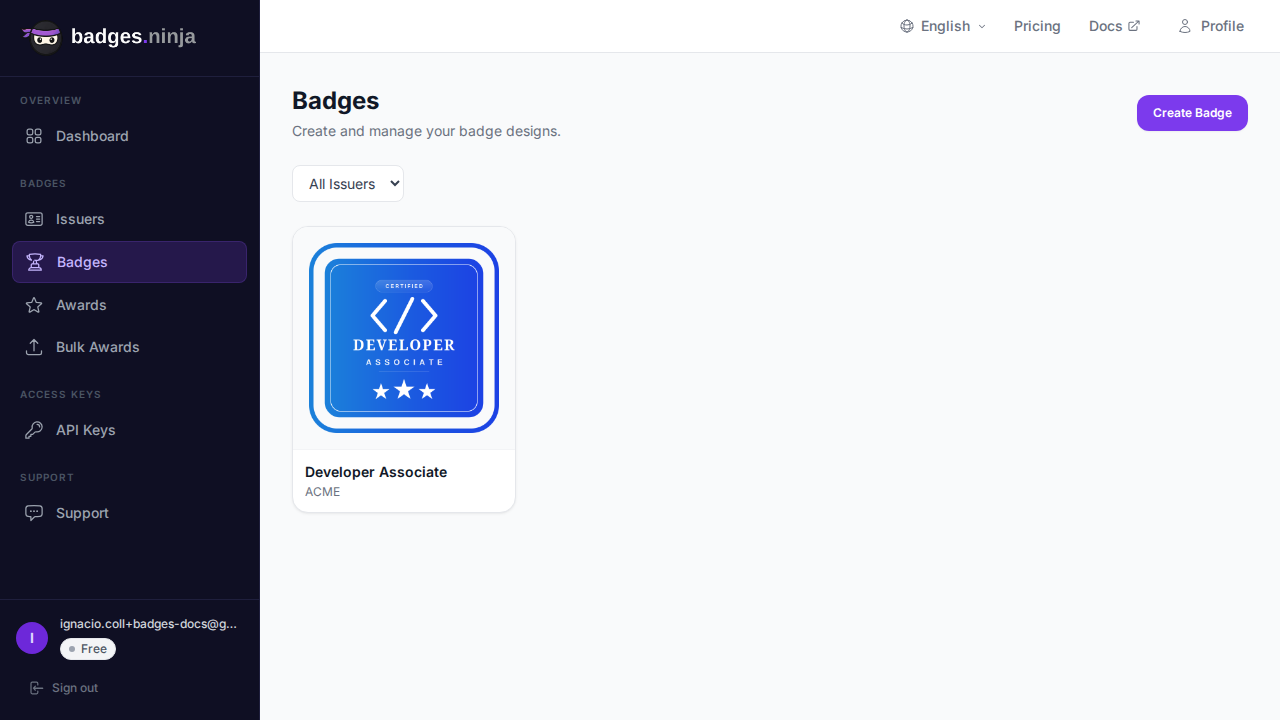
Design freedom on both platforms comes from a fixed template library rather than a free-form editor — you’re picking a layout and adjusting colors, logos, and text rather than placing shapes, icons, and custom fonts on a canvas. That’s a deliberate trade-off: it keeps output consistent at enterprise scale, but it also means neither platform is where you’d go if badge aesthetics and creative control are a priority for your program.
Pricing: Two Enterprise Sales Processes
Neither Credly nor Accredible lists pricing on its website, and that’s not an oversight — it reflects how both companies sell. Expect a demo, a needs-assessment call, a proposal scoped to your credential volume and feature list, and a contract with a minimum term. Based on public reporting and customer accounts, Accredible’s published-adjacent pricing tends to start in the hundreds of dollars per month and scale with volume and features, while Credly’s contracts for mid-size and large organizations commonly run into five and six figures annually once network and integration features are included.
For an organization issuing tens of thousands of credentials a year with a dedicated budget line for credentialing infrastructure, that cost is proportionate to the value: enterprise support, integrations, and — for Credly specifically — a recipient network that took a decade to build. But most organizations evaluating “Credly vs Accredible” aren’t issuing at that scale. They’re a training provider, a certification body, or a university department issuing a few hundred to a few thousand credentials a year, and for that group, the enterprise sales cycle and price point are simply a mismatch with the actual requirement: design a badge, issue it, let it be verified.
The Honest Middle-Market Problem
Here’s the pattern we see consistently: organizations start evaluating Credly or Accredible because those are the names that come up first, go through the sales process, get a quote, and then realize the contract assumes a volume and feature set they don’t need yet. They end up either overpaying for enterprise infrastructure at small-issuer volume, or they give up on verifiable credentials entirely and fall back to a plain PDF certificate — which solves nothing on the verification or portability side.
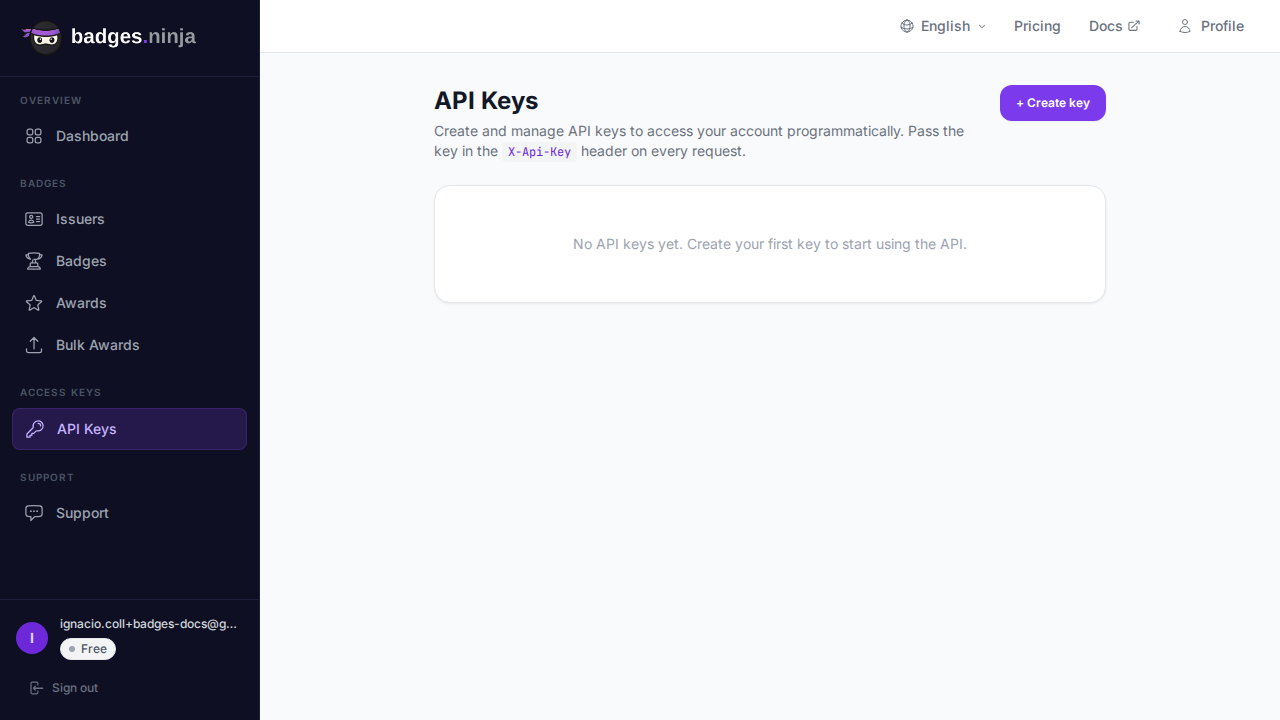
If that’s your situation, it’s worth looking at badges.ninja before signing an enterprise contract. It issues the same standards-based Open Badge v2.0 credentials — hosted verification page, QR code, PDF certificate, and Add-to-LinkedIn-Profile support — on self-serve monthly plans with no sales call: Free at $0/month (2 issuers, 5 badge classes, 1,200 credentials/year, 2 seats, 1 API key), Starter at $9/month, and Pro at $29/month. There’s no white-label branding and no Credly-style recipient network — those are the honest limitations — but for a program issuing hundreds to low thousands of credentials a year, it’s a full credentialing workflow without an enterprise procurement cycle attached to it.
The REST API is available on every plan, not gated behind an enterprise tier:
const res = await fetch("https://api.badges.ninja/awards", {
  method: "POST",
  headers: { "X-Api-Key": API_KEY, "Content-Type": "application/json" },
  body: JSON.stringify({
    badgeId: "your-badge-id",
    recipient: { name: "Jane Smith", email: "jane@example.com" },
    issuedOn: Date.now(),
  }),
});
const { awardId } = await res.json();
const verifyUrl = `https://badges.ninja/awards/${awardId}`;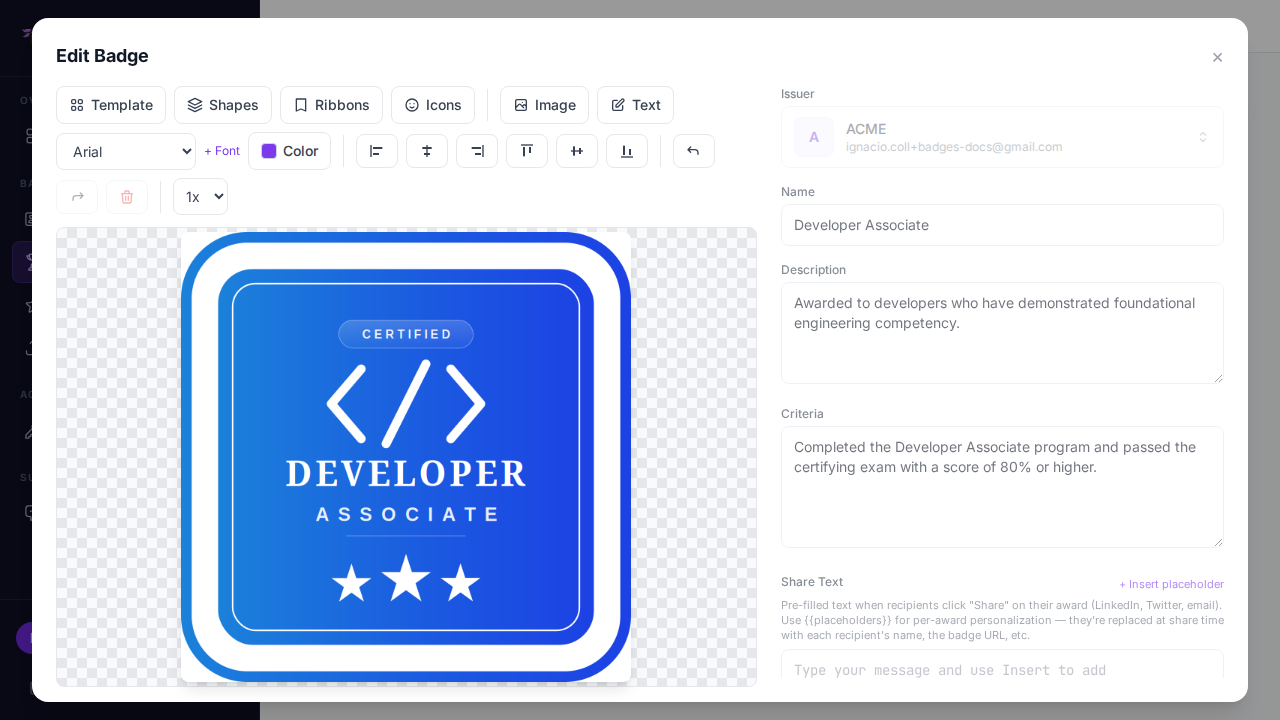
That request creates the award, and the response comes back as a plain { awardId } you use to build the verification URL — no separate provisioning step, no minimum contract to unlock the endpoint.
We cover each enterprise platform on its own terms in more depth elsewhere: see our Credly alternative comparison for the full Credly-vs-Badges-Ninja breakdown (pricing, design, migration story), and our Accredible alternative comparison for the equivalent against Accredible. Both go deeper than we can here on cost comparisons and what you’d give up by switching.
Decision Framework
Choose Credly if you:
- Need your recipients discoverable inside an existing talent-marketplace and recruiter ecosystem
- Issue at a volume where enterprise SSO and directory integration matter operationally
- Value a shared recipient network over full white-label branding
- Have budget and procurement bandwidth for an enterprise contract
Choose Accredible if you:
- Need the entire recipient and verification experience under your own brand and domain
- Rely on deep integrations with Moodle, Canvas, Blackboard, or similar LMS platforms
- Need detailed geographic and demographic analytics for institutional reporting
- Are comfortable with enterprise pricing that scales with volume and features
Consider badges.ninja if you:
- Issue in the hundreds-to-low-thousands range annually, not tens of thousands
- Want to start issuing this week, not after a sales cycle
- Need a real API on every plan, including the free tier
- Don’t currently need white-label branding or a cross-issuer recipient network
Making the Call
Credly and Accredible are both mature, capable platforms — the “which is better” question mostly dissolves once you’re honest about what your program actually needs. If discoverability inside an existing recruiter network is the point of your credential, Credly’s ecosystem is the differentiator money can’t easily replicate elsewhere. If institutional brand control and reporting depth are the priority, Accredible’s white-label and analytics investment shows.
But if you’re comparing these two mainly because they’re the names that show up first in search results, it’s worth pricing out what you actually need against what a self-serve platform delivers before you sign an annual enterprise contract. For a lot of training providers and certification bodies, the right answer isn’t “Credly or Accredible” — it’s neither, at least not yet.
Ready to issue your first verifiable credential? Start free at badges.ninja — visual designer, public verification page, PDF certificate, Open Badge v2.0 output. No credit card required.
About the author
Nacho Coll
Founder & Engineer at Badges Ninja
Nacho founded Badges Ninja to make issuing verifiable digital credentials as simple as a single API call — Open Badge v2.0 badges and certificates, minted, hosted, and verifiable without standing up your own issuer infrastructure. Writes about the Open Badges spec, credential verification, and running a credentialing platform serverless on AWS, from the operator side of the wire.