Open Badges Platform Comparison: Every Major Tool, Side by Side
The definitive side-by-side comparison of Open Badge v2.0 platforms — features, pricing tiers, API access, and standards compliance in one table.
 By Nacho Coll
 Nacho founded Badges Ninja to make issuing verifiable digital credentials as simple as a single API call — Open Badge v2.0 badges and certificates, minted, hosted, and verifiable without standing up your own issuer infrastructure.
If you’ve searched “open badges platform comparison,” you’ve probably hit two kinds of pages: a single vendor’s own “us vs the competition” post, or a thin roundup that never quite says who costs what. Neither answers the actual question a program owner has when they start evaluating Open Badge software: which platform fits my volume, my budget, and my recipients, and which ones are overkill or underpowered for what I’m running.
This page is the neutral, full-market version. Every platform below issues Open Badge v2.0 credentials, so the differences that actually matter are pricing model, whether you get a visual designer or a template picker, whether the API is included or gated behind a sales call, and how issuance is verified. We keep this table current and link out to a dedicated, deeper comparison for every platform named here.
The Full Comparison Table (2026)
| Platform | Open Badge v2.0 | Free Tier | Entry Paid Plan | Visual Designer | API on Every Plan | Public Verification Page |
|---|---|---|---|---|---|---|
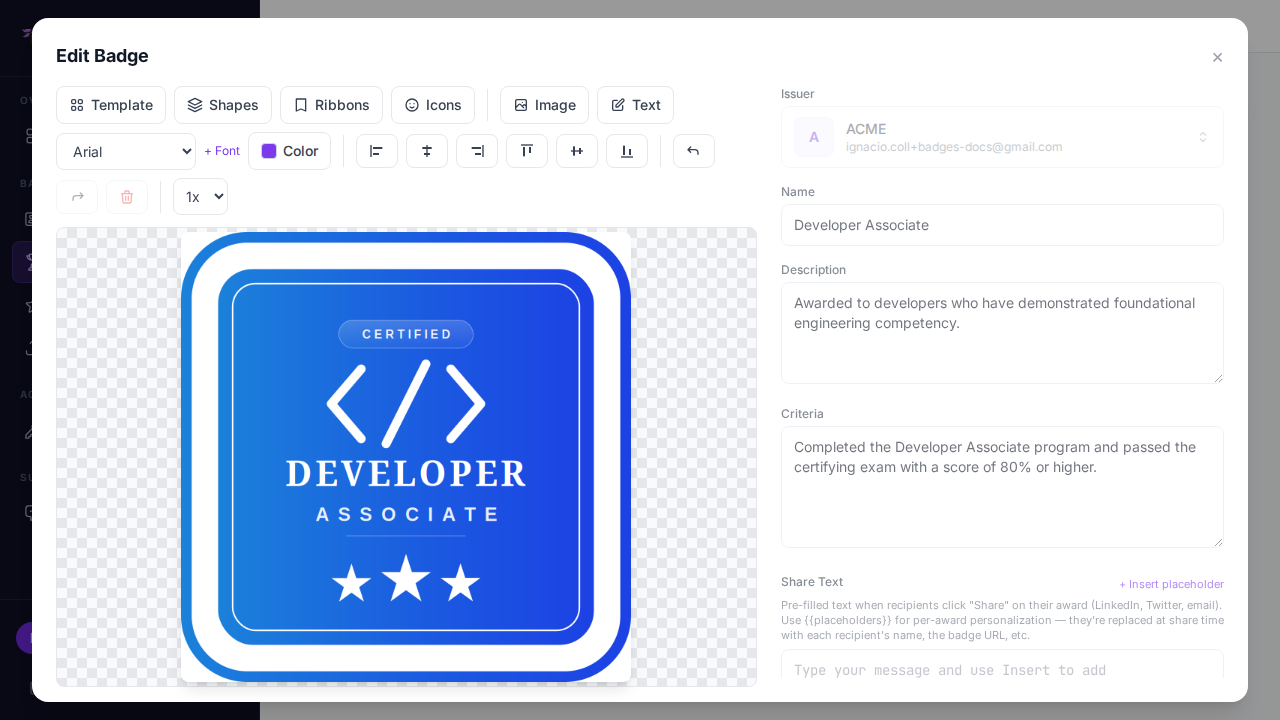
| Badges Ninja | Yes | $0 — 1,200 credentials/year, no monthly ceiling | Starter, $9/month (12,000/year) | Yes — 80+ templates, shapes, icons | Yes, including free | Yes, every plan |
| Credly | Yes | None | Enterprise, contact sales | Limited | Enterprise tier only | Yes |
| Badgr | Yes | 100 badges/month, no rollover | Around $50/month | Basic | Paid plans | Yes |
| Accredible | Yes | 10 badges total (trial) | $99/month | Yes, on paid plans | Paid plans | Yes |
| Sertifier | Yes | 10 badges total (trial) | $59/month | Yes | Paid plans | Yes |
| Open Badge Factory | Yes | Sales-led, no published free tier | Contact sales | Basic | Enterprise tier | Yes |
| Certifier | Yes | $0 — 250 credentials/year | Around $67-79/month (3,000/year cap) | Yes | Gated by tier | Yes |
| VirtualBadge | Yes | Sales-led, no free tier | Custom, thousands/year | Yes | Enterprise | Yes |
| POK | Yes, plus blockchain anchoring | None, enterprise contracts | Reported €10,000-€50,000+/year | Limited | Enterprise | Yes |
| BCdiploma | Yes, plus blockchain notarization | None, enterprise contracts | Reported $50,000-$200,000+/year | Limited | Enterprise | Yes |
| Hyperstack | Yes | Sales-led, no published free tier | Custom, institutional | Yes | Enterprise | Yes |
Where a vendor doesn’t publish pricing, the figure above is a reported range from public quotes and buyer reports, not an official list price — confirm current terms directly with the vendor.
Three Shapes of This Market
Once you sort these eleven platforms by how they sell and who they’re built for, they fall into three distinct groups, and most of the confusion in “which platform should I pick” questions comes from comparing across groups instead of within one.
Self-Serve Platforms for Programs Under 10,000 Credentials a Year
Badges Ninja, Badgr, Sertifier, and Certifier all let you sign up with an email address and issue your first credential the same day, no sales call required. Within this group the real differences are how generous the free tier is, whether the API and bulk CSV upload are included or gated, and how the paid tiers scale.
Badges Ninja’s free tier covers 1,200 credentials a year as a flexible annual pool with no monthly ceiling, and includes the visual designer, the API, and bulk CSV upload from day one. Badgr’s free tier resets monthly at 100 badges with no rollover, which works for a steady monthly cadence but breaks down around graduation ceremonies or cohort-based programs where issuance spikes. Sertifier and Certifier both frame their free tier as a trial (10 and 250 credentials respectively) rather than a production tier, with API access typically arriving only on a paid plan.
Enterprise, Sales-Led Platforms
Credly, Accredible, VirtualBadge, and Hyperstack are built for large organizations with procurement processes, and they price accordingly — none of them publish a self-serve price list, and getting a number usually means a sales conversation. In exchange, they offer things a self-serve tool doesn’t: deep integrations with existing HR/LMS stacks, white-label branding, dedicated account management, and analytics dashboards built for reporting up to leadership. If your program issues tens of thousands of credentials a year through an existing enterprise software stack, that overhead buys real capability. If you’re a training team of two issuing a few hundred badges a quarter, it’s a lot of platform for the job.
The four aren’t interchangeable, either. Credly’s strength is its employer-facing network effect — recruiters and hiring managers already browse it, which matters most for certifications tied to a hiring decision. Accredible leans harder into analytics and white-label presentation, which suits programs that need to report engagement numbers up to a board. VirtualBadge and Hyperstack both compete more on managed service than on network reach: expect a dedicated onboarding process and ongoing account support rather than a self-serve dashboard you configure yourself.
EU-Institutional and Blockchain-Notarized Platforms
Open Badge Factory, POK, and BCdiploma serve a narrower, specific need: European data residency, university-grade compliance frameworks, or cryptographic notarization on a blockchain rather than a hosted verification page. Open Badge Factory has the longest track record here, with Finnish-hosted infrastructure and a decade of EU university adoption. POK adds ELM (European Learning Model) compatibility and blockchain anchoring aimed at university transcripts. BCdiploma goes further still, notarizing diplomas on-chain with a patent portfolio behind the approach. All three are strong fits if your institution specifically requires blockchain notarization or EU data residency as a compliance checkbox — and expensive overkill if it doesn’t.
Standards and Verification: What “Open Badge v2.0” Actually Guarantees
Every platform in this table issues Open Badge v2.0 credentials, which means the underlying assertion is JSON-LD with a defined schema: an issuer, a BadgeClass, and an assertion linking a recipient to that BadgeClass with an issue date and a verification method. That standard is what lets a badge from one platform be recognized by tools that understand the spec, and it’s why “Open Badge compliant” is table stakes rather than a differentiator on its own.
What differs is how verification is exposed. Most platforms, including Badges Ninja, host a public verification page with no signup required — a recruiter or hiring manager can click a link and see the credential is real. On Badges Ninja that page lives at a predictable URL per award, and the same assertion is available as raw Open Badge v2.0 JSON-LD for programmatic checks:
curl https://api.badges.ninja/certify-badge/award/your-award-idNo API key required for that endpoint — verification is intentionally public. The human-readable equivalent is https://badges.ninja/awards/<award-id>, which is the link recipients share on LinkedIn or in an email signature.
One more standards wrinkle worth knowing before you pick a platform: Open Badge v3.0 exists as a newer W3C Verifiable Credentials-based spec, but the ecosystem hasn’t moved there yet — LinkedIn’s Add-to-Profile flow, most badge wallets, and every platform in this table are built around v2.0 today. Unless a specific verifier is already demanding v3, v2.0 is the safer choice for 2026; see Open Badge v2 vs v3 for the full migration timeline.
Bulk Issuance: CSV Upload vs Manual Entry
If you’re issuing to a cohort rather than one recipient at a time, look past the marketing copy and check whether bulk issuance is actually included on the tier you’d be paying for, and whether it survives an interrupted browser session. On the self-serve platforms, bulk CSV upload is usually available but sometimes reserved for a paid tier (Sertifier and Certifier both gate it above their free/trial tier). Badges Ninja includes CSV bulk upload with pause-and-resume on every plan, including free — you can close the tab mid-batch and pick up where you left off, since the job state lives server-side rather than in the browser. On the enterprise-tier platforms, bulk issuance is typically included but often runs through an account manager or an LMS integration rather than a self-serve upload screen, which adds turnaround time but also adds validation for large, messy institutional data.
API Access: Included Everywhere, or Gated to a Tier
If you plan to issue credentials automatically from an LMS, a CRM, or a course-completion webhook rather than one at a time through a dashboard, API access is the column that matters most — and it’s the one most comparison pages gloss over. Look closely at the table above and a pattern shows up: on most of these platforms, API access is a paid-tier or enterprise feature, not something you get to test on a free account.
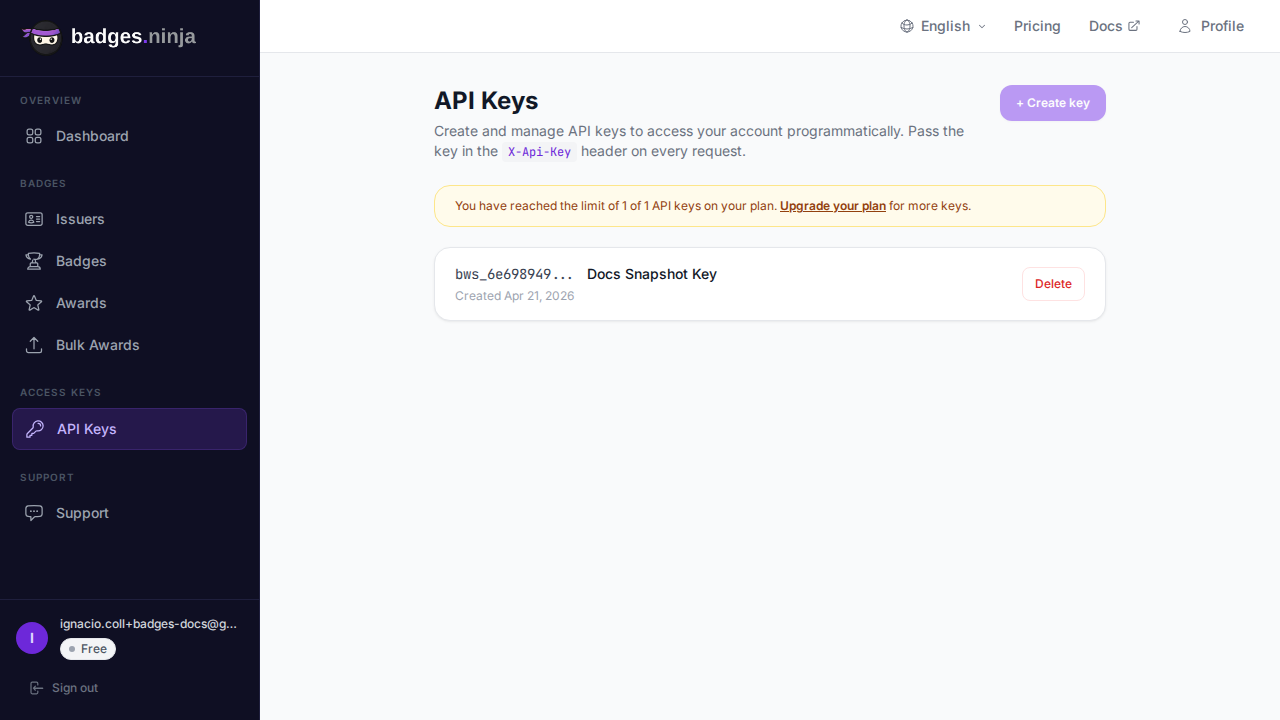
Badges Ninja includes full API access on every plan, including free — one API key on Free, five on Starter, twenty on Pro. Keys are created and revoked from the dashboard, each shown once in full at creation and masked afterward.
Issuing a credential from your own code is a single authenticated request:
const res = await fetch("https://api.badges.ninja/awards", {
  method: "POST",
  headers: { "X-Api-Key": API_KEY, "Content-Type": "application/json" },
  body: JSON.stringify({
    badgeId: "your-badge-id",
    recipient: { name: "Jane Smith", email: "jane@example.com" },
    issuedOn: Date.now(),
  }),
});
const { awardId } = await res.json();
That request returns an awardId, and the verification page is https://badges.ninja/awards/<awardId>. Being able to run that exact call on a $0 account, before committing to anything, is a meaningfully different evaluation experience than requesting API docs from a sales rep after signing a contract.
Migration: What Actually Changes When You Switch
Because every platform here outputs Open Badge v2.0, moving from one to another isn’t a rebuild from zero — it’s three concrete steps. First, you recreate your badge designs in the new platform’s designer (or upload existing artwork if the platform accepts custom images). Second, you bulk-import your recipient list, typically via CSV, so historical awards exist in the new system too. Third, you point whatever triggers issuance — an LMS completion hook, a CRM stage change, a manual dashboard action — at the new platform’s flow or API instead of the old one.
Credentials you already issued on the old platform keep working wherever they were shared; switching platforms doesn’t retroactively break a PDF someone downloaded last year or a link they posted on LinkedIn. What changes going forward is where new awards live and which verification URL you’re pointing people to. Budget more time for programs with heavy custom branding or deep LMS integrations (the enterprise-tier platforms above), and less for straightforward badge-and-certificate programs on self-serve tools.
How to Choose
Match your situation to a group rather than a single vendor:
- Under 10,000 credentials a year, budget-conscious, want to try the API before committing — start with Badges Ninja’s free tier, or Badgr if your issuance is a steady, predictable monthly count with no seasonal spikes.
- Need deep integrations with an existing enterprise HR or LMS stack, and have a procurement process anyway — Credly or Accredible are built for exactly that motion; expect a sales conversation and a five-figure-plus annual contract.
- Specifically require EU data residency or blockchain notarization as a compliance requirement — Open Badge Factory, POK, or BCdiploma, in roughly that order of institutional weight and price.
- Want white-glove onboarding and don’t have internal capacity to self-serve — VirtualBadge or Hyperstack trade self-serve speed for a managed setup.
For a head-to-head against any single competitor named above — pricing broken down further, feature-by-feature tables, and migration specifics — see the dedicated comparison linked from that platform’s row. Two good next stops if you’re still narrowing down: the cheapest Open Badges platform in 2026 if price is the deciding factor, or best Open Badges platforms in 2026 if you’re ranking on overall value.
Ready to issue your first verifiable credential? Start free at badges.ninja — visual designer, public verification page, PDF certificate, Open Badge v2.0 output. No credit card required.
About the author
Nacho Coll
Founder & Engineer at Badges Ninja
Nacho founded Badges Ninja to make issuing verifiable digital credentials as simple as a single API call — Open Badge v2.0 badges and certificates, minted, hosted, and verifiable without standing up your own issuer infrastructure. Writes about the Open Badges spec, credential verification, and running a credentialing platform serverless on AWS, from the operator side of the wire.