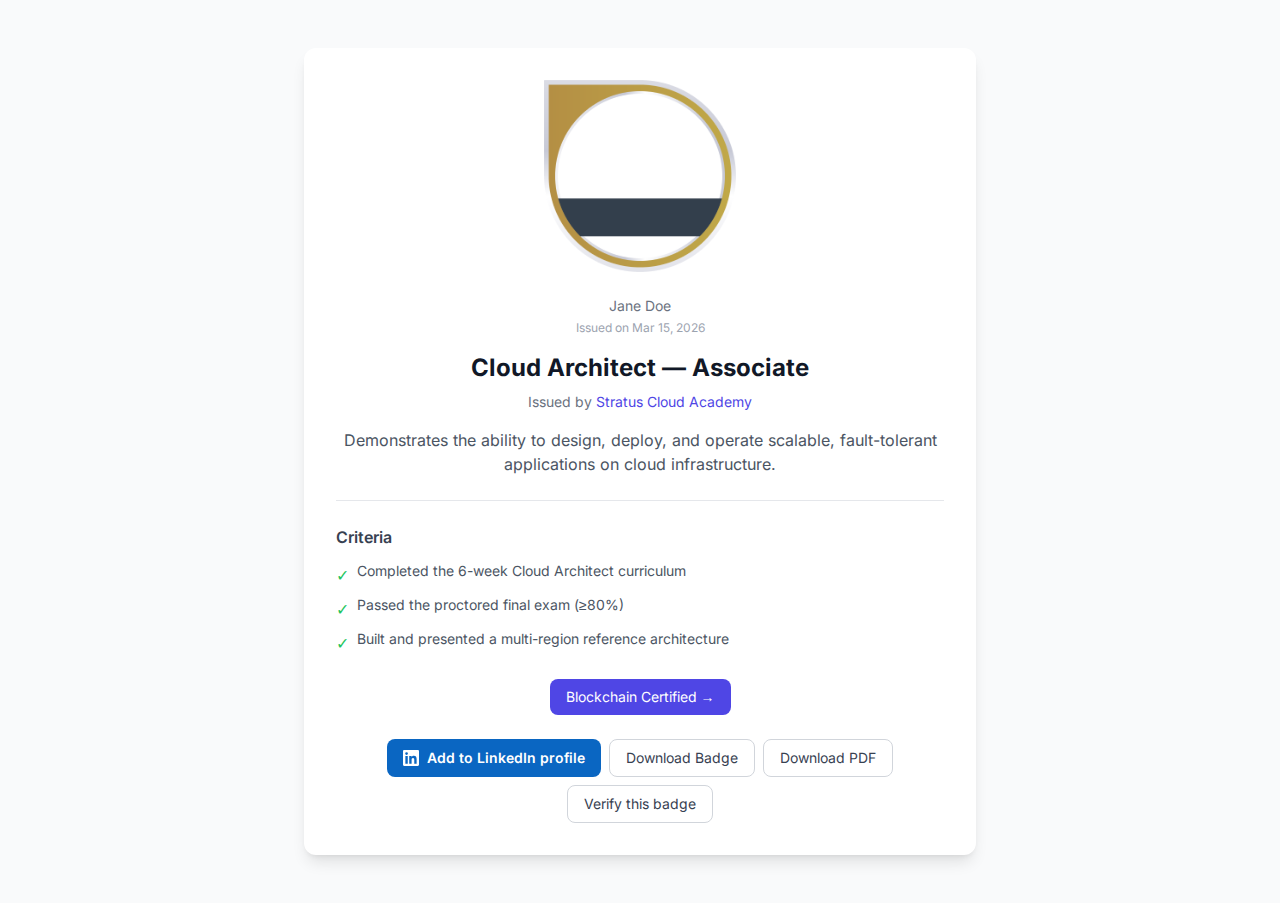
POK Alternative: Open Badges With a Free Tier and Self-Serve Flow
POK is heavy on universities + ELM compliance and blockchain anchoring. Badges Ninja delivers standards-based Open Badges with a free tier, a visual designer, and a self-serve flow.
 By Nacho Coll
 Nacho founded Badges Ninja to make issuing verifiable digital credentials as simple as a single API call — Open Badge v2.0 badges and certificates, minted, hosted, and verifiable without standing up your own issuer infrastructure.
If you’re researching digital credential platforms, you’ve likely encountered POK (Proof of Knowledge) — a blockchain-based credentialing platform that’s made waves in European universities and corporate training. POK promises tamper-proof credentials anchored on blockchain technology, which sounds compelling for organizations serious about credential integrity.
But here’s the thing: blockchain verification is just one piece of the credentialing puzzle. Your choice of platform depends on your audience, budget, compliance requirements, and how quickly you need to get started issuing credentials.
This article compares POK with Badges Ninja across the dimensions that matter most to training providers, universities, and certification bodies. The two platforms take genuinely different approaches: POK leans on blockchain anchoring and EU compliance, while Badges Ninja is a self-serve, standards-based issuer built on the Open Badge v2.0 specification. Their pricing, onboarding, and target markets differ significantly.
POK €10K-€50K/yr vs Badges Ninja Free: Compliance and Pricing Table
| POK | Badges Ninja | |
|---|---|---|
| Target audience | Universities, large enterprise | Training providers, bootcamps, corporate teams |
| ELM compliance | Yes (native) | No (Open Badge v2.0 standard) |
| EU hosting | Yes | Not required for compliance |
| Free tier | None — enterprise contracts only | Yes, unlimited time |
| Onboarding | Sales calls + implementation support | Self-serve, minutes |
| Verification model | On-chain anchoring (Ethereum + consortium) | Hosted public verification + permanent image hosting |
POK has carved out a strong position in the European higher education market, and for good reason. If you’re a university or large enterprise with specific compliance requirements, POK offers several compelling advantages:
University-First Design
POK was built with universities in mind, and it shows. Their credential templates align well with academic structures — degree programs, course completions, research certifications. The platform understands the nuances of academic credentialing, from transcript integration to alumni verification workflows.
ELM Compliance and EU Hosting
For European institutions, POK’s European Learning Model (ELM) compliance is a significant advantage. ELM is the EU standard for describing learning achievements digitally, and POK’s native support means credentials integrate seamlessly with European educational frameworks.
All POK infrastructure runs within EU data centers, which matters for GDPR compliance and data sovereignty requirements that many European institutions face. If blockchain-notarized university diplomas specifically (not just badges) are your use case, our BCdiploma alternative comparison covers that match-up.
Enterprise-Grade Blockchain Integration
POK anchors credentials on multiple blockchain networks, including Ethereum and their own consortium blockchain. This multi-chain approach provides redundancy and ensures long-term verification even if one blockchain becomes unavailable.
The blockchain integration isn’t just marketing — credentials include cryptographic proofs that allow independent verification without relying on POK’s infrastructure.
White-Label Customization
POK offers extensive white-labeling options for large clients. Universities can fully customize the credential verification experience to match their branding, domain, and user experience requirements.
Where POK Falls Short
However, POK’s university-first approach creates limitations for other types of credential issuers:
No Free Tier
POK operates on enterprise pricing only. There’s no free trial or starter plan for smaller organizations to test the platform. This creates a high barrier to entry for training providers, bootcamps, or certification bodies that want to experiment with digital credentials.
Complex Onboarding
Getting started with POK requires sales conversations, contract negotiations, and technical implementation support. While this works well for universities with dedicated IT teams, it’s overkill for smaller organizations that need to issue credentials quickly.
Limited Visual Design Options
POK’s credential designs tend toward academic formality. If you’re issuing certificates for creative skills, technical bootcamps, or professional development, the design options may feel restrictive compared to more flexible platforms.
Blockchain Dependency
While blockchain verification provides security benefits, it also introduces complexity. Recipients need to understand blockchain concepts to fully leverage credential verification, which can be a barrier in some audiences.
How Badges Ninja Differs
Badges Ninja takes a different approach to verifiable credentials, focusing on accessibility and ease of use while maintaining strong security standards:
Open Badge v2.0 Standard
Instead of proprietary blockchain protocols, Badges Ninja builds on the Open Badge v2.0 specification — the global standard for digital credentials. This ensures interoperability with any compliant verification system or digital backpack. See the full Open Badge Authentication docs for implementation details.
The Open Badge approach means recipients can import their credentials into platforms like LinkedIn Learning, Mozilla Backpack, or their organization’s learning management system without vendor lock-in.
Self-Serve Onboarding
You can create an issuer account, design your first badge, and issue credentials within minutes. No sales calls, no contracts, no technical implementation required. This speed matters when you need to launch credential programs quickly or test different approaches. Get started in minutes with our Getting Started guide.
Visual Badge Designer
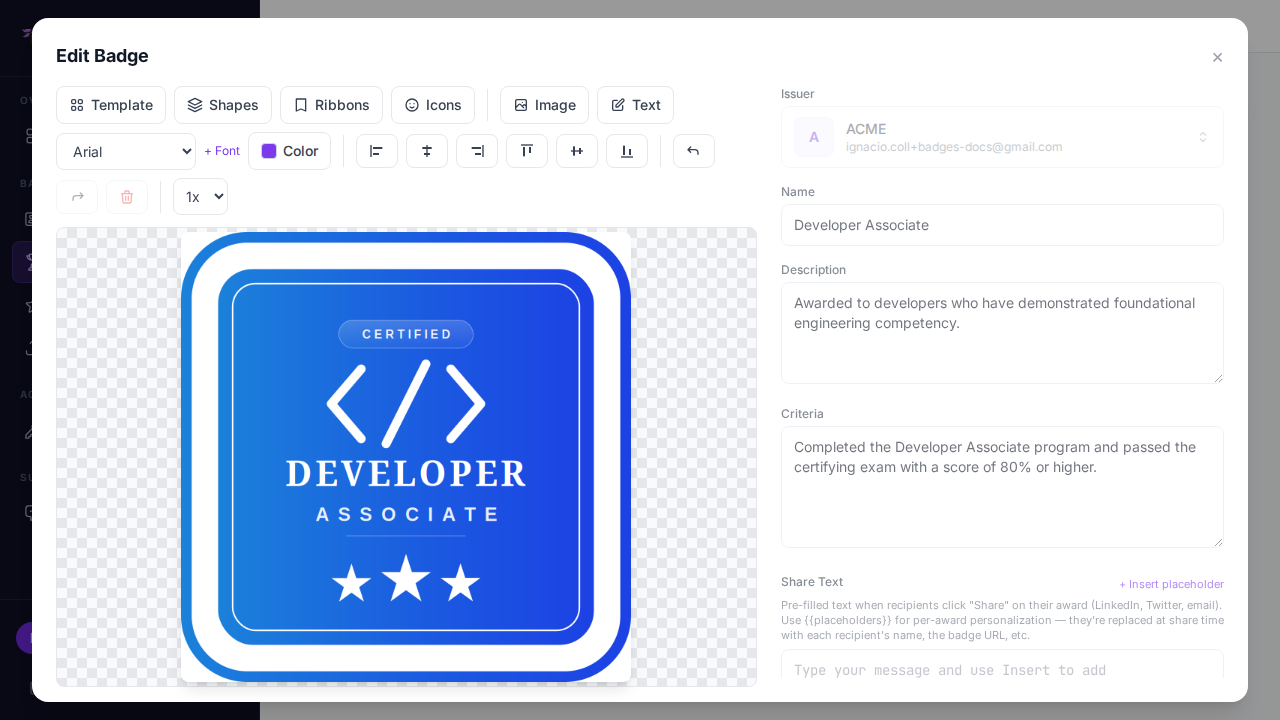
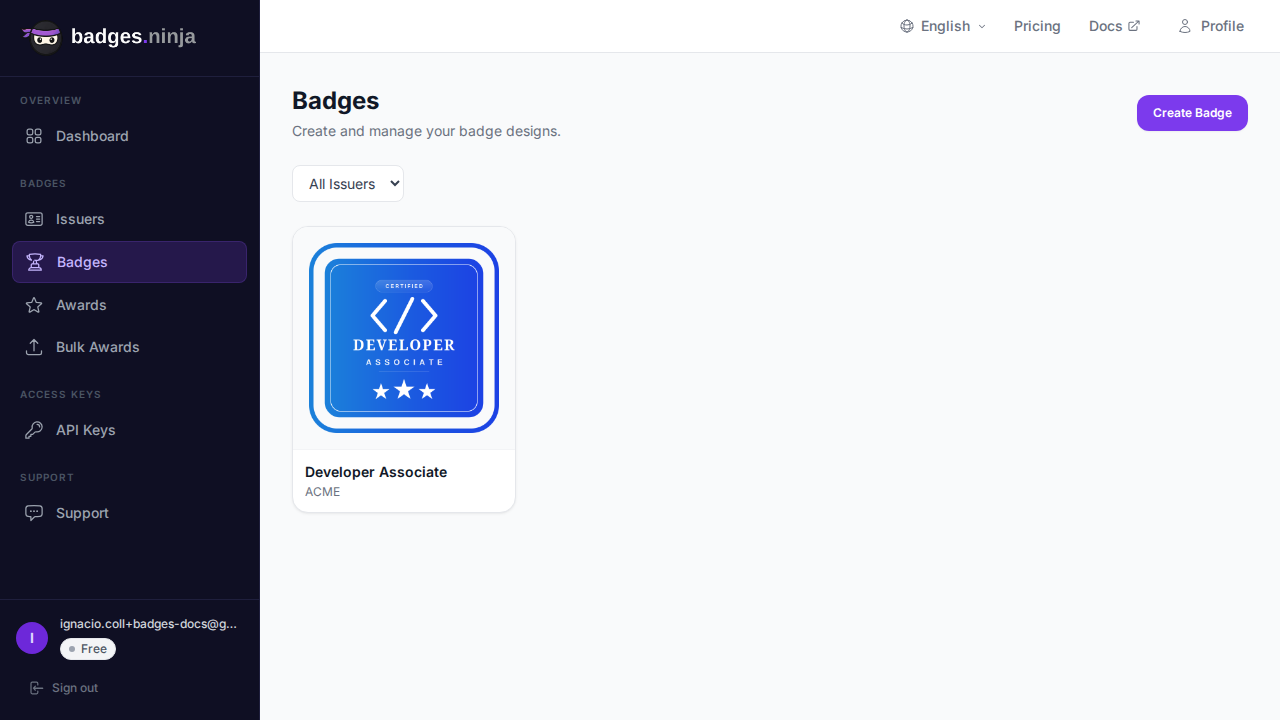
Badges Ninja includes a comprehensive visual designer with 80+ shape templates, 8 color palettes, 50 icons, and 11 fonts. You can upload custom fonts and backgrounds, use snap-to-grid alignment, and preview exactly how your credentials will appear across different contexts.
Free Tier + Transparent Pricing
The platform offers a genuinely free tier for individual instructors and small programs. Paid plans start at $9/month for teams and $29/month for organizations issuing at scale. No hidden fees, no per-credential charges, no surprises.
Standards-Based Verification + Permanent Image Hosting
Here’s where it gets practical: Badges Ninja pairs the Open Badge v2.0 standard with hosted public verification pages and permanent, content-addressed credential images. Each credential lives at a stable public URL that anyone can check in a browser — no wallet, no explorer, no blockchain literacy required.
Because badge images are stored under immutable, content-hashed URLs and the verification data follows the Open Badge specification, credentials stay portable and durable. Recipients can import them into any Open Badge-compliant backpack, and the standard itself keeps them verifiable regardless of any single vendor’s roadmap.
Technical Implementation Comparison
For organizations with technical teams, the implementation differences matter:
POK Integration
POK typically requires API integration for bulk issuance and custom verification workflows. Their REST API supports enterprise identity providers and can integrate with existing student information systems.
// POK API example (simplified)
const response = await fetch('https://api.pok.tech/v1/credentials', {
  method: 'POST',
  headers: {
    'Authorization': 'Bearer ' + accessToken,
    'Content-Type': 'application/json'
  },
  body: JSON.stringify({
    recipientId: 'student@university.edu',
    credentialTemplate: 'degree-template-id',
    achievementData: {...}
  })
});
Badges Ninja Integration
Badges Ninja offers both REST API and bulk CSV upload options. The API is designed for self-service integration:
// Badges Ninja API example
const response = await fetch('https://api.badges.ninja/awards', {
  method: 'POST',
  headers: {
    'X-Api-Key': 'bws_' + apiKey,
    'Content-Type': 'application/json'
  },
  body: JSON.stringify({
    badgeId: 'badge-12345',
    recipient: {
      name: 'Jane Smith',
      email: 'jane@company.com'
    },
    issuedOn: '2026-06-08'
  })
});
For non-technical teams, Badges Ninja’s bulk credentials feature lets you upload a CSV file with recipient information and issue hundreds of credentials with a few clicks.
Verification and Sharing
Both platforms prioritize credential verification, but with different approaches:
POK Verification
POK credentials include blockchain proofs that can be verified independently using blockchain explorers. Recipients get a verification URL that shows the credential details and cryptographic proof of authenticity.
The blockchain approach provides maximum security but requires recipients to understand concepts like transaction hashes and smart contracts.
Badges Ninja Verification
Badges Ninja provides public verification pages that work like traditional web pages — no blockchain knowledge required. Each credential gets:
- A public verification URL (badges.ninja/awards/{guid})
- QR code for mobile verification
- PDF certificate download
- Open Graph tags for rich social media previews
- LinkedIn “Add to Profile” integration
Recipients can share credentials on social media, include them in email signatures, or add them directly to LinkedIn profiles with one click.
Decision Framework: Which Platform Fits Your Needs?
Choose POK if you are:
- A European university with ELM compliance requirements
- An enterprise with dedicated IT resources
- Issuing formal academic credentials (degrees, diplomas, certificates)
- Required to meet specific data sovereignty requirements
- Willing to invest in enterprise-level implementation
Choose Badges Ninja if you are:
- A training provider, bootcamp, or certification body
- Starting your first credential program
- Working with limited technical resources
- Needing visual flexibility for diverse credential types
- Wanting to test digital credentials before major investment
- Prioritizing recipient ease-of-use over maximum security
Cost Comparison
The pricing models reflect each platform’s target market:
POK Pricing:
- Enterprise contracts only
- Custom pricing based on volume and requirements
- Typical university contracts range from €10,000-€50,000+ annually
- Includes implementation support and white-labeling
Badges Ninja Pricing:
- Free tier: Individual use, basic features
- Starter: $9/month for teams and training providers
- Pro: $29/month for organizations issuing at scale
- All plans include visual designer, verification, and Open Badge compliance
For context, a training provider issuing 1,000 credentials annually fits inside Badges Ninja’s free tier — a 1,200-per-year credential pool at $0 — versus tens of thousands with POK’s enterprise model.
Integration with Existing Systems
Both platforms support integration with learning management systems and HR platforms, but with different approaches:
POK excels at deep integration with university information systems, student records, and academic workflow tools. Their enterprise focus means dedicated implementation support for complex integrations.
Badges Ninja focuses on standard integrations that work across industries — bulk CSV uploads, a REST API on every plan, webhook notifications, and LinkedIn “Add to Profile.” The bulk CSV workflow keeps issuing accessible to non-technical teams, while the API and webhooks cover programmatic and event-driven use cases.
Do You Actually Need Blockchain?
Blockchain anchoring sounds reassuring, but it’s worth asking what problem it actually solves for your credentials — and whether you need it at all.
POK makes blockchain verification central to their value proposition. Credentials are anchored on-chain, and verification can involve blockchain interaction. For a university issuing formal degrees under a legal and regulatory framework, that immutability and decentralization can genuinely matter — it’s a strong fit for institutions with those specific integrity and compliance mandates.
But for most issuers, the real requirements are simpler: credentials that can’t be quietly forged, that recipients can share and check without special tooling, and that stay verifiable for years. Those needs are met well by the Open Badge v2.0 standard combined with hosted public verification pages and permanent image hosting — which is exactly what Badges Ninja provides. Anyone can open a verification URL in a browser, confirm the issuer and the achievement, and trust that the record follows a global, portable standard rather than a single vendor’s database.
So the honest answer is: if your context specifically demands on-chain anchoring or EU/university ELM compliance, POK is built for that. If you mainly need trustworthy, shareable, standards-based credentials that recipients can actually use, you likely don’t need blockchain at all — and a self-serve Open Badge platform gets you there faster and cheaper.
Making Your Decision
The choice between POK and Badges Ninja ultimately depends on your specific context:
If you’re a European university with formal compliance requirements and enterprise resources, POK’s specialized approach may justify the investment. The ELM compliance alone could be worth the cost for institutions operating in the EU educational framework.
If you’re a training provider, certification body, or corporate learning team that needs to issue verifiable credentials quickly and cost-effectively, Badges Ninja’s self-serve approach removes barriers while maintaining professional credibility.
Consider also your recipients’ context. University students may expect formal, blockchain-verified credentials that integrate with academic systems. Professional learners in bootcamps or corporate training often prioritize LinkedIn integration and easy sharing over maximum cryptographic security.
Both platforms deliver on the core promise of verifiable digital credentials. The difference lies in implementation philosophy: enterprise complexity versus self-serve accessibility.
For organizations just starting with digital credentials, beginning with Badges Ninja’s free tier lets you test recipient engagement and refine your credentialing strategy before committing to enterprise-level solutions.
The credential landscape continues evolving rapidly. What matters most is choosing a platform that aligns with your current needs while providing flexibility as your program grows. Whether that’s POK’s enterprise blockchain approach or Badges Ninja’s accessible Open Badge implementation depends on your specific context and constraints.
Ready to issue your first verifiable credential? Start free at badges.ninja — visual designer, public verification page, PDF certificate, Open Badge v2.0 output. No credit card required.
About this article: This comparison was researched and drafted with AI assistance, then fact-checked and edited by the Badges Ninja team. Pricing and feature details reflect our understanding as of the publish date above — always confirm current terms directly with the vendor before making a purchasing decision.
Frequently asked questions
How much does POK cost compared to Badges Ninja?
Is POK ELM compliant, and does Badges Ninja support that too?
Do I need a sales call to start issuing credentials with Badges Ninja like I do with POK?
Do I need to understand blockchain to verify a Badges Ninja credential?
About the author
Nacho Coll
Founder & Engineer at Badges Ninja
Nacho founded Badges Ninja to make issuing verifiable digital credentials as simple as a single API call — Open Badge v2.0 badges and certificates, minted, hosted, and verifiable without standing up your own issuer infrastructure. Writes about the Open Badges spec, credential verification, and running a credentialing platform serverless on AWS, from the operator side of the wire.