
Blockchain Certificates vs Open Badges: Which for Digital Credentials in 2026?
Blockchain certificates vs Open Badge v2.0: how verification, portability, and cost differ — and when each makes sense for issuing digital credentials.
 By Nacho Coll
 Nacho founded Badges Ninja to make issuing verifiable digital credentials as simple as a single API call — Open Badge v2.0 badges and certificates, minted, hosted, and verifiable without standing up your own issuer infrastructure.
If you’ve spent any time researching digital credentials, you’ve run into two competing pitches. One says your certificates need to live “on the blockchain” — immutable, decentralized, tamper-proof. The other says you need Open Badges — a well-established, interoperable standard that already works with LinkedIn, applicant tracking systems, and every major issuing platform. Both claim to solve the same problem: proving a credential is real without a phone call to the registrar.
They’re not actually opposites. But the marketing around each has muddied what “blockchain certificate” even means, and issuers end up choosing a technology stack before they understand what problem they’re solving. This post breaks down what’s really different between the two approaches, where the “blockchain vs Open Badges” framing is a false choice, and how to pick an issuing platform without getting locked into infrastructure you don’t need.
What “blockchain certificate” actually means
“Blockchain certificate” isn’t one thing — it covers a few distinct architectures that get lumped together in marketing copy:
1. Hash-anchored certificates. The credential itself (a PDF, an image, a JSON document) lives in a normal database. A cryptographic hash of that document — not the document itself — gets written to a public blockchain (usually Ethereum or a permissioned chain). Anyone can re-hash the original file and compare it to the on-chain record to confirm nothing changed. This is the most common pattern among “blockchain credential” vendors, including university-focused platforms like BCdiploma and POK.
2. Fully on-chain credentials. The credential data itself is stored on-chain, often as an NFT or a custom token standard. Rare in practice — gas costs and public-chain data limits make this impractical for anything beyond a small pilot.
3. W3C Verifiable Credentials (VCs). A cryptographic signing standard where the issuer signs a claim with a private key, and anyone can verify the signature against the issuer’s published public key — no blockchain required at all, though VCs are sometimes paired with a blockchain-based DID (decentralized identifier) registry. This is the direction Open Badge 3.0 is heading, and it’s worth reading in more depth in our Open Badge v2 vs v3 comparison.
The common thread across all three: verification is delegated to cryptography instead of a phone call to the registrar. That’s the actual value proposition, and it’s one that Open Badge v2.0 — the current, cryptographic-signing-optional, most widely adopted spec — already delivers without a blockchain.
What Open Badge v2.0 actually verifies
An Open Badge v2.0 credential is a JSON-LD document — a structured, machine-readable assertion that says “issuer X issued badge Y to recipient Z on date D,” with an evidence URL and criteria attached. The verification model is hosted verification: the assertion lives at a stable, issuer-controlled URL, and anyone — a recruiter, an HR system, an applicant tracking bot — can fetch that URL and get the current, authoritative state of the credential, including whether it’s since been revoked.
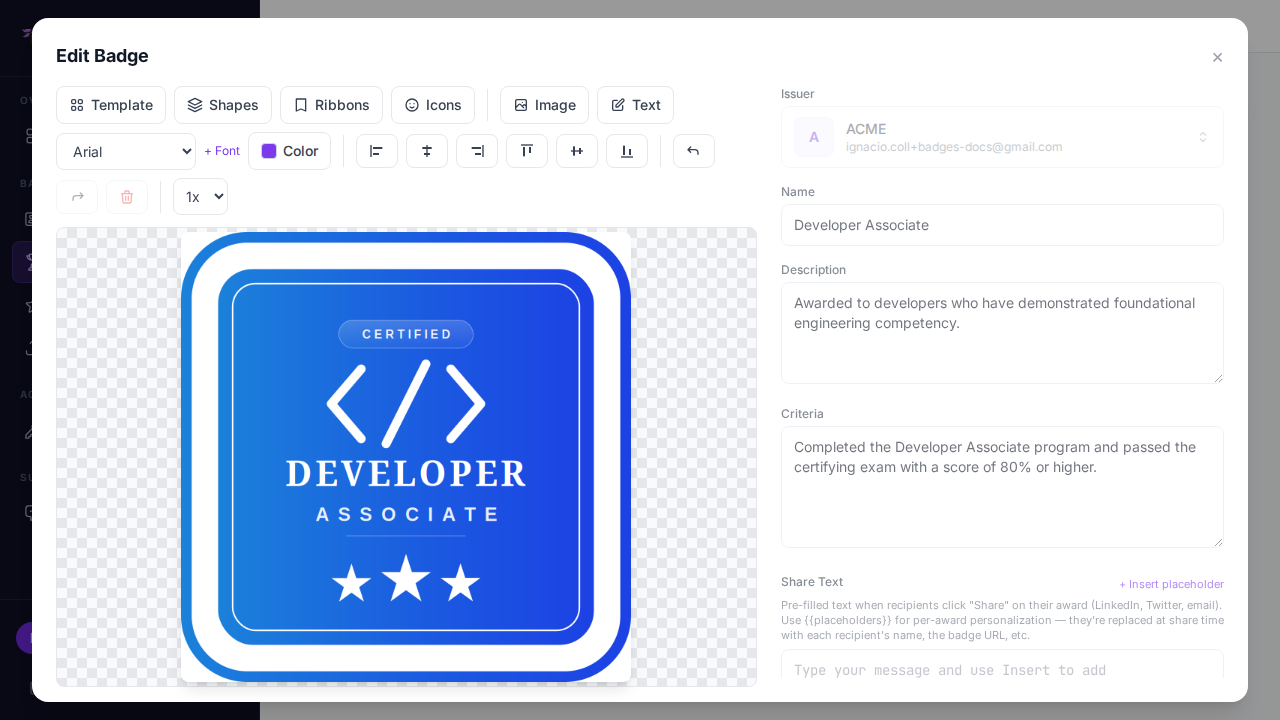
This is different from a blockchain hash-anchor in one important way: a blockchain hash-anchor proves a document hasn’t been tampered with since it was issued. Hosted OBv2 verification proves the credential’s current, live status — issued, revoked, or expired — because the verifier is always checking the source of truth, not a static snapshot. If a credential gets revoked six months after issuance (a certification lapses, a violation is discovered), a hash-anchored PDF still hashes to the same value it always did — the anchor says nothing about revocation. A hosted OBv2 verification page reflects the revocation immediately. You can see the full field-by-field shape of a credential assertion in the awards API guide and API reference.
Portability: wallets vs URLs
Blockchain-anchored credential platforms often emphasize wallet portability — the idea that a recipient “owns” their credential the way they own a cryptocurrency wallet, independent of any platform staying online. That’s a real property, and for institutions worried about vendor lock-in over a 20-year time horizon, it matters.
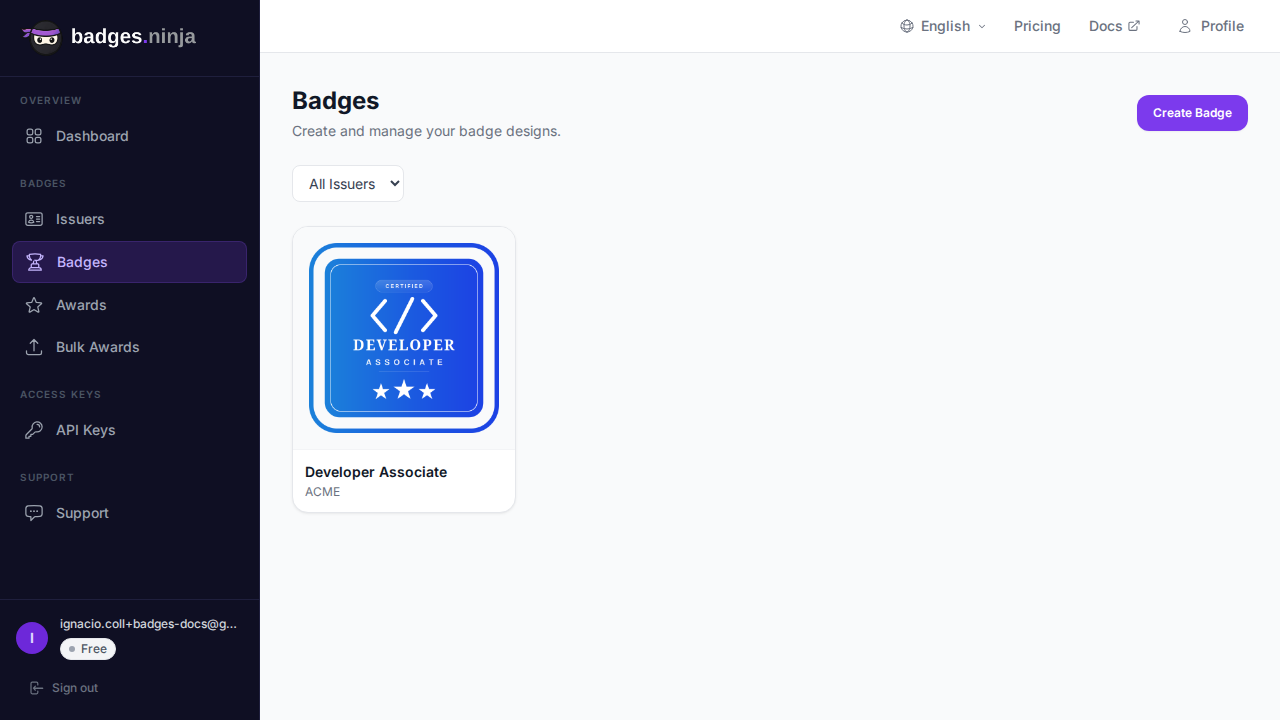
In practice, though, portability for the recipient today is decided by one thing: can they put it on LinkedIn with one click? Open Badges already win that fight decisively. A badges.ninja recipient gets a public profile at badges.ninja/u/{handle}, a shareable verification URL, a downloadable PDF certificate, and a LinkedIn “Add to Profile” button that pre-fills the certification dialog — no wallet software, no seed phrase, no gas fee. Recruiters and hiring managers don’t check blockchain explorers; they click the LinkedIn certification link. If your goal is recipient reach and credibility signal, hosted verification with a URL beats an on-chain hash nobody outside your registrar’s office knows how to read.
Cost and complexity
This is where the two approaches diverge hardest. Blockchain-anchored issuance typically means:
- Gas fees per credential (even on low-fee chains, this adds real operational cost at volume)
- Wallet infrastructure for issuers and often for recipients
- A dependency on a specific chain staying economically viable and accessible
- Enterprise sales cycles — most blockchain credential vendors sell to universities and large institutions with custom contracts, not self-serve signup
Open Badge v2.0 issuance, by contrast, is just structured JSON served over HTTPS. There’s no per-credential blockchain transaction cost, no wallet dependency, and no reason issuance has to be enterprise-only. That’s reflected directly in pricing: badges.ninja issues Open Badge v2.0 credentials starting at $0/month (Free tier), scaling to $9/mo (Starter) and $29/mo (Pro) — no per-credential gas fee, no contract negotiation. If you’re comparing total cost across the category, our cheapest Open Badges platform breakdown covers where blockchain-anchored platforms land on price relative to hosted-verification alternatives.
What about durability without a blockchain?
The strongest argument the blockchain side makes is durability: what happens to a credential in 20 or 30 years if a platform migrates, reorganizes, or shuts down? It’s a fair question — but a public ledger isn’t the only answer, and for almost everyone it’s the wrong one.
Hosted verification pairs naturally with permanent, content-addressed storage. On badges.ninja, every credential’s badge image is stored permanently under an immutable, content-hashed URL, so the visual artifact stays retrievable by its content hash for the life of the credential — you get durable, tamper-evident storage without gas fees, wallets, or a chain dependency. Combined with the Open Badge v2.0 assertion served over HTTPS, that covers the durability concern for the overwhelming majority of issuers: training providers, bootcamps, corporate L&D teams, and professional associations.
A narrow set of regulated niches — certain government or cross-border credential-recognition frameworks — do reference on-chain notarization explicitly, and those institutions will have their compliance requirements spelled out for them. Outside of those specific mandates, an on-chain hash buys you a portability guarantee your recipients will never actually exercise, at the cost of real complexity.
The practical recommendation for 2026
For most issuers, the right architecture is: Open Badge v2.0 hosted verification today, with a clear eye on OB 3.0 / W3C Verifiable Credentials as that ecosystem matures. OB 3.0 gets you cryptographic, issuer-signed verification — the actual security property blockchain anchoring is usually sold on — without requiring a chain, gas fees, or wallet software at all. It’s the standards-track version of “cryptographically verifiable,” and it’s coming from the same 1EdTech body that maintains OBv2, which means it’ll interoperate with the LinkedIn / ATS / LMS ecosystem you already depend on.
If you’re operating under a specific government or institutional mandate that dictates a particular verification format, follow the requirement your compliance team hands you — several vendors build specifically for those constraints, and we cover how the category compares in our BCdiploma alternative and POK alternative breakdowns. For everyone else — training programs, bootcamps, corporate compliance teams, professional associations — hosted Open Badge v2.0 verification, backed by permanent image hosting, gets you the same practical outcome (a credential nobody can fake, that verifies instantly, that recipients actually share) without the infrastructure overhead.
Ready to issue your first verifiable credential? Start free at badges.ninja — visual designer, public verification page, PDF certificate, Open Badge v2.0 output. No credit card required.
Frequently asked questions
What does "blockchain certificate" actually mean?
Is an Open Badge v2.0 as secure as a blockchain-anchored certificate?
Does issuing credentials on a blockchain cost more than Open Badges?
Will a credential without a blockchain last 20 or 30 years?
About the author
Nacho Coll
Founder & Engineer at Badges Ninja
Nacho founded Badges Ninja to make issuing verifiable digital credentials as simple as a single API call — Open Badge v2.0 badges and certificates, minted, hosted, and verifiable without standing up your own issuer infrastructure. Writes about the Open Badges spec, credential verification, and running a credentialing platform serverless on AWS, from the operator side of the wire.