
Open Badge Factory Pricing (2026): Plans, Costs, and a Free Option
Open Badge Factory's 2026 pricing tiers explained, with per-badge costs — and how Badges Ninja compares for issuers who want a free Open Badge v2.0 tier.
 By Nacho Coll
 Nacho founded Badges Ninja to make issuing verifiable digital credentials as simple as a single API call — Open Badge v2.0 badges and certificates, minted, hosted, and verifiable without standing up your own issuer infrastructure.
If you’ve searched “Open Badge Factory pricing 2026” hoping for a simple price list, you’ve probably hit the same wall most people do: a marketing page that talks about plans in general terms, a “request a quote” form, and not much else in the way of a number you can put in a budget spreadsheet. That’s not an accident — Open Badge Factory (OBF) has spent over a decade building relationships with universities, vocational schools, and certification bodies across Europe, and institutional software in that world is sold, not self-served.
This is a straightforward breakdown of how OBF’s pricing actually works — the tiers, what typically gates you into a sales conversation, and what’s usually bundled in — plus an honest look at what the same kind of issuing program costs on Badges Ninja, which publishes its pricing and includes a permanent free tier.
How Open Badge Factory Structures Its Pricing
OBF sells access as an organizational subscription rather than a per-credential meter. The general shape, based on how the platform is publicly described and how issuers report their onboarding experience, looks like this:
| Tier | Who it’s for | What’s typically included | How pricing works |
|---|---|---|---|
| Free trial | Evaluating the platform | Full or near-full feature access, time-boxed | No cost, limited evaluation window |
| Organization plans | Schools, training providers, certification bodies | Badge design tools, issuer branding, Finnish/EU hosting, OBv2 output | Annual license fee, tiered by organization size/usage |
| Enterprise / institutional | Universities, large vocational networks, multi-site issuers | Custom domains, deeper integration support, dedicated onboarding | Custom quote, negotiated annually |
Two things matter more than the exact euro figure, which shifts over time and by region: first, OBF’s pricing is organization-level, not usage-level — you’re licensing the platform for your institution for a year, not paying per badge issued. Second, almost every real quote requires a conversation, because OBF’s customer base skews toward institutions with procurement processes, framework agreements, and negotiated terms rather than a credit card checkout. If you’re trying to forecast next year’s line item from the public site alone, you’ll come up short — that’s the exact gap behind the “open badge factory pricing 2026” and “open badge factory pricing official” searches that keep showing up with no dedicated answer page.
What You’re Actually Paying For
To be fair to OBF, the annual license isn’t just a badge-issuing meter — it’s largely why the platform still leads in European public-sector and higher-education adoption. The subscription typically covers:
- EU-hosted infrastructure — Finnish data centers and a compliance track record institutions have relied on since 2014.
- Institutional badge design tools — a template-driven designer built for consistency across a large organization’s badge catalog, not necessarily rapid one-off design.
- Multi-user, multi-role administration — built for teams where several staff members issue badges under one organizational umbrella.
- OBv2 (and increasingly OBv3) compliance — standards-based, portable credential output that works with the wider Open Badges ecosystem.
For a university credentialing office or a vocational school issuing thousands of badges a year across departments, that bundle — plus the institutional trust of a decade-plus track record — is genuinely worth an annual license fee. The open question for smaller programs is whether they need an institution-shaped platform and its institution-shaped pricing, or whether a flat, self-serve monthly plan gets them the same OBv2 credential without the procurement cycle.
The Cost Gap: Annual License vs. Flat Monthly Plans
Badges Ninja takes a different approach: no annual license negotiation, no organization-size tiering, no sales call required to see a number. The three plans are public and fixed:
| Plan | Price | Issuance limit |
|---|---|---|
| Free | $0/month | 1,200 credentials/year, no time limit, API included |
| Starter | $9/month | 12,000 credentials/year |
| Pro | $29/month | 120,000 credentials/year |
Run this against a small-to-mid training provider issuing a few hundred to a couple thousand badges a year — a single certificate program, a bootcamp, a professional-development office running a handful of cohorts. On Badges Ninja, that’s $9–$29 a month, full stop, whether issuance is 300 badges or 3,000. On an OBF-style annual license, the fee is set by the organization’s plan tier, and small programs can end up paying for institutional-scale infrastructure (multi-role admin, custom domains, dedicated onboarding) they don’t need yet.
The honest trade-off: OBF’s decade of EU compliance history and institutional integrations (student information systems, LMS platforms with deep institutional hooks) aren’t something a newer, flat-priced platform replicates overnight. If your issuing program already lives inside a university’s procurement and IT ecosystem, that maturity has real value that a lower sticker price doesn’t offset on its own.
Where Small Issuers Feel the Cost Gap Most
The pricing model difference shows up most clearly at two points in a program’s lifecycle:
Getting started. OBF’s sales-quote process means a pilot program — a single department wanting to try Open Badges before committing institution-wide — has to go through the same procurement motion as a full rollout, even for a small first cohort. A free, no-time-limit tier removes that friction entirely: a program lead can design a badge, issue it to a real cohort, and show stakeholders a working verification page before anyone signs a purchase order.
Scaling unevenly. Institutional licenses are typically set for a year based on projected usage. A program that grows faster than expected — more departments adopting badges mid-year, an unplanned cohort — either operates inside headroom already built into the license or triggers a renegotiation. A flat monthly plan doesn’t have that friction: growth from 500 to 5,000 annual credentials doesn’t change the bill on Badges Ninja’s Starter or Pro tiers, because pricing is set by feature access, not badge count.
Neither of these is a knock on OBF’s model — annual institutional licensing is a deliberate choice that matches how universities buy software, with budget cycles and framework agreements. It’s simply the wrong shape for a program that wants to start small, prove value, and pay only for what it uses from day one.
Frequently Asked Questions
Does Open Badge Factory have a free plan? OBF offers a time-limited free trial to evaluate the platform, not an ongoing free tier for production use. After the trial, continued issuance requires an organizational license. Badges Ninja’s Free plan has no time limit — it’s capped at 1,200 credentials per year rather than by days, so a small pilot can run indefinitely at no cost.
Is Open Badge Factory pricing published anywhere? Not as a fixed public price list. OBF’s pricing is quoted per organization based on size, usage, and negotiated terms — typical of institutional EdTech sales in the European higher-education and vocational-training market.
What does an OBF quote typically depend on? Organization size (number of active issuers and administrators), expected issuance volume, and whether you need enterprise features like custom domains or deeper system integrations. Institutions already inside a national or regional education framework agreement sometimes get pricing set at that level rather than negotiated individually.
Can I compare OBF and a flat-priced alternative without committing my program’s data? Yes — OBF’s trial and Badges Ninja’s permanent Free plan can both be evaluated without payment, which makes a small side-by-side pilot (same badge design, same cohort) a reasonable way to compare the actual issuing and recipient experience before an institution-wide decision.
When Open Badge Factory’s Pricing Model Is the Right Call
This isn’t a case for switching regardless of context. OBF’s licensing model earns its cost when:
- Your organization needs EU/Finnish data residency as a hard compliance requirement, not just a preference.
- You’re issuing under an institutional umbrella — multiple departments, shared administration, and a decade-plus vendor relationship your procurement team already trusts.
- You expect to negotiate pricing as part of a framework agreement or public-sector contract, where custom terms are the norm rather than the exception.
- Your program is large enough that per-badge cost effectively approaches zero once the annual license is amortized across thousands of credentials.
If that’s your situation, the annual license is buying institutional maturity and procurement fit, not just a badge-issuing tool.
When a Flat, Self-Serve Plan Wins
Badges Ninja’s flat pricing tends to win for programs that:
- Want to see the exact price before talking to anyone — no quote request, no sales call, no procurement cycle to run a pilot.
- Are starting small — a single course, a departmental pilot, a first cohort — and don’t yet know if issuance volume will justify an institutional license.
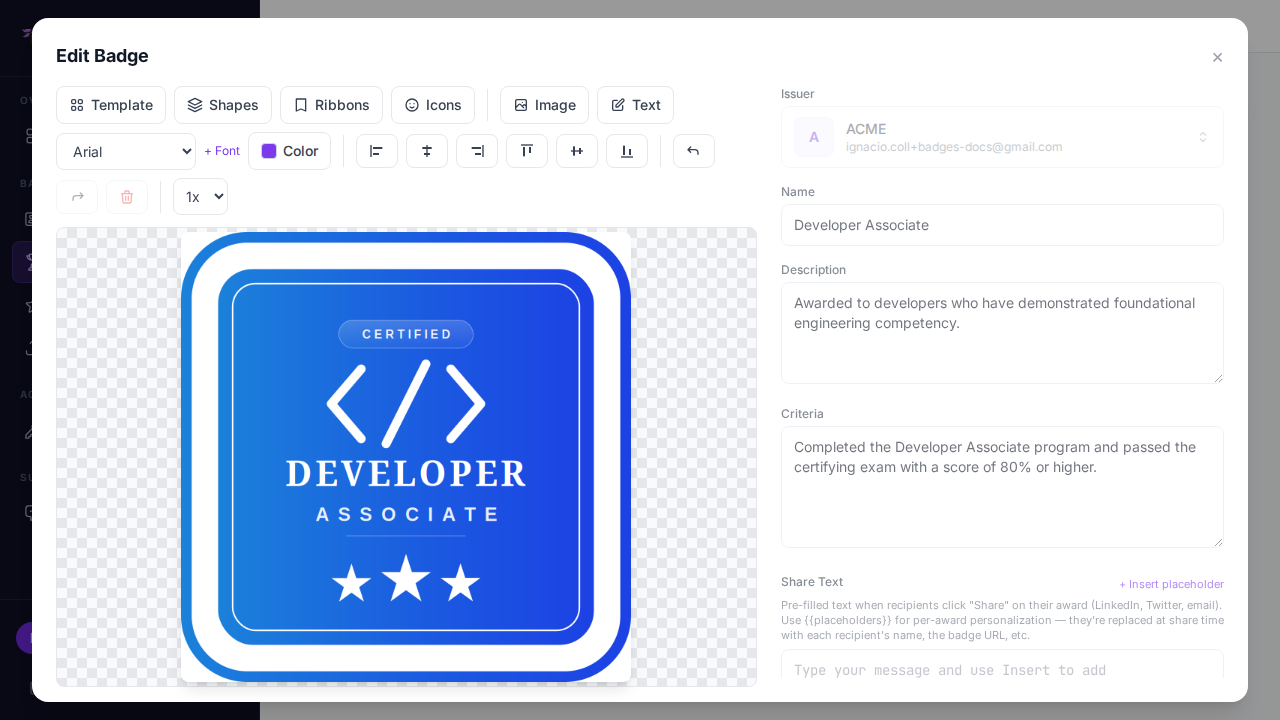
- Want full visual design control without working inside a fixed, institution-oriented template gallery — 80+ shape templates, 8 color palettes, custom font uploads, and snap-to-grid alignment in the badge designer.
- Care about the recipient experience: badges.ninja/me gives every recipient magic-link sign-in (no password) and a public profile at
badges.ninja/u/{handle}aggregating every credential they’ve earned, from any issuer on the platform.
Both platforms produce standards-compliant Open Badge output, so recipients can add either one to LinkedIn and third parties can verify either independently of who issued it. Pricing model doesn’t change credential portability — it changes how predictably you can budget for it.
Working Out Your Own Number
Because OBF doesn’t publish per-organization pricing, the only reliable comparison is to request a quote for your actual institution size and set it next to a flat $9 or $29 a month. As a rough gut-check: on an annual license model, your effective per-credential cost falls as issuance volume grows within the license, but the entry cost is fixed regardless of how small your first pilot is. On a flat monthly plan, entry cost is near zero and effective per-credential cost falls the more you issue, with no annual commitment to renegotiate. For small-to-mid programs proving out a first cohort, that difference in entry friction is usually the deciding factor — institutions already deep in OBF’s ecosystem will find the license fee is buying compliance heritage a newer platform hasn’t built yet.
For a fuller feature-by-feature look beyond pricing — designer, API, recipient experience — see our Open Badge Factory alternative comparison. And if you’re weighing pricing across the whole Open Badges market rather than just OBF, the cheapest Open Badges platforms in 2026 lays every major vendor’s tiers side by side.
Ready to issue your first verifiable credential? Start free at badges.ninja — visual designer, public verification page, PDF certificate, Open Badge v2.0 output. No credit card required.
About the author
Nacho Coll
Founder & Engineer at Badges Ninja
Nacho founded Badges Ninja to make issuing verifiable digital credentials as simple as a single API call — Open Badge v2.0 badges and certificates, minted, hosted, and verifiable without standing up your own issuer infrastructure. Writes about the Open Badges spec, credential verification, and running a credentialing platform serverless on AWS, from the operator side of the wire.