
Sertifier vs Credly: Pricing, Features, and the Cheaper Third Option
Sertifier vs Credly compared on pricing, design, Open Badge compliance, and recipient UX — plus a free alternative for teams that want neither's contract.
 By Nacho Coll
 Nacho founded Badges Ninja to make issuing verifiable digital credentials as simple as a single API call — Open Badge v2.0 badges and certificates, minted, hosted, and verifiable without standing up your own issuer infrastructure.
If you’re evaluating credentialing platforms, “Sertifier vs Credly” is the search that comes up once you’ve narrowed the field to two serious contenders and you’re trying to figure out which one actually fits your budget and your program. Both issue verifiable digital certificates and badges. Both talk to LinkedIn. Both will happily sell you an enterprise contract. And both, frankly, are built for a scale and a sales process that a lot of training teams, bootcamps, and internal L&D groups don’t need.
This is a head-to-head on the two platforms — pricing model, design freedom, Open Badge compliance, and the recipient experience — plus an honest look at where a free/$9-a-month third option fits if neither Sertifier nor Credly is the right shape for your program.
The short version
- Credly is the enterprise incumbent. Deep integrations (Salesforce, Workday, LMS platforms), strong brand recognition among recipients, and a sales-led pricing model that means you won’t see a number until you talk to someone.
- Sertifier positions itself as the more self-serve, mid-market option — hosted email delivery, analytics dashboards, and published (if still contact-gated at volume) pricing tiers.
- Badges Ninja is the free-to-start option: a visual badge designer, an Open Badge v2.0-compliant issuance flow, and a recipient portal, without a sales call or an annual minimum.
None of these are strictly “better” — they’re built for different buyers. Here’s the detail.
Pricing model
Neither Sertifier nor Credly makes pricing fully self-explanatory, which is itself a signal about who they’re built for.
Credly doesn’t publish issuer pricing at all. You request a demo, a sales rep scopes your recipient volume and integration needs, and you get a quote — typically an annual contract sized for hundreds or thousands of credentials. That’s standard enterprise SaaS behavior, and if you’re a large certification body or a Fortune 500 L&D team, the white-glove process and the account management that comes with it can be worth it.
Sertifier is more transparent at the entry level — published tiers exist for smaller volumes — but once your program needs meaningful recipient counts, you’re back to a “contact sales” conversation and a credit- or seat-based model that’s hard to predict from the outside. If you’ve ever tried to estimate what a 5,000-recipient cohort will actually cost on either platform before signing anything, you know the friction.
Badges Ninja flips that: Free tier covers real usage (up to 1,200 credentials/year), Starter is $9/month, Pro is $29/month. No credit-based math, no “request a quote” wall. You can see the exact ceiling of each tier on the pricing page before you create an account.
| Credly | Sertifier | Badges Ninja | |
|---|---|---|---|
| Published pricing | No — sales only | Partial (entry tiers) | Yes — Free / $9 / $29 |
| Free tier | No | Limited trial | Yes, ongoing |
| Contract required at scale | Yes | Often | No |
| Self-serve signup | No | Yes (small volume) | Yes |
Design freedom
Credly’s badge visuals are template-driven and, by design, fairly constrained — the platform optimizes for consistency across thousands of issuers, not bespoke design. Sertifier gives you more layout control for certificates specifically, with a template library aimed at diplomas and course completions.
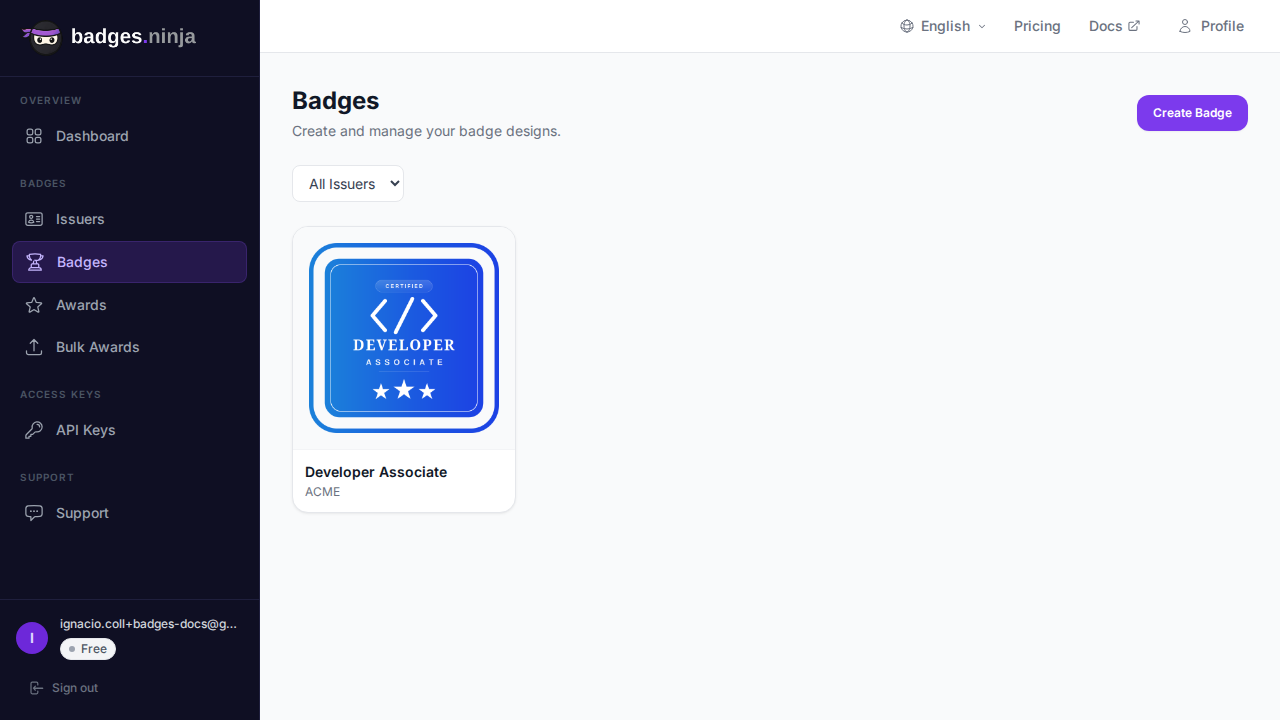
Badges Ninja’s visual designer is the differentiator here: 80+ shape templates, custom icon and logo upload, 11 fonts, full color control, and snap-to-grid alignment — all inside the same flow you use to create the badge, not a separate design tool you export from and re-upload.
If your brand identity matters — a bootcamp with a distinct visual language, a conference with sponsor-tier badge tiers, an association with a house style — the designer gap between “pick from a template” and “build the exact badge you want” shows up the first week you use it.
Open Badge compliance
This is the one area where all three platforms are functionally equivalent, and it’s worth saying plainly: Credly, Sertifier, and Badges Ninja all issue Open Badge v2.0-compliant credentials with JSON-LD assertions, public verification, and LinkedIn’s Add-to-Profile integration. If your only requirement is “the credential must be an Open Badge,” none of these three loses on spec compliance.
Where they diverge is what’s around the badge: Credly’s recipient network effects (badge earners recognize the Credly interface because they’ve seen it from other issuers), Sertifier’s certificate-specific formatting, and Badges Ninja’s combination of badge and auto-generated PDF certificate from the same credential, plus a recipient portal at badges.ninja/me that recipients sign into with a magic link — no password to forget.
Recipient experience
Credly’s recipient experience is mature and recognizable — many professionals have already seen a Credly badge notification from a different issuer, which can work in your favor (familiarity) or against you (your badge looks like everyone else’s).
Sertifier’s recipient flow centers on the delivered email and a hosted certificate/badge page; it’s clean but less built around an ongoing “wallet” concept.
Badges Ninja’s recipient portal treats every credential as part of a running collection: recipients sign in passwordless, see every badge they’ve earned across every issuer on the platform, and get a public profile URL (badges.ninja/u/{handle}) they can drop into a resume or bio. Each credential also ships with a unique verification URL, a QR code, and a downloadable PDF — so recipients get options for how they want to share it, not just an emailed image.
Integrations and API access
Credly’s real strength for large organizations is its integration surface — connectors and partnerships with major LMS platforms, HRIS systems, and certification bodies that have been building on Credly’s API for years. If you already have a Workday or Salesforce-centric stack and want a vendor who has “seen this before,” that maturity is worth something.
Sertifier’s API is more modest but covers the essentials — issuing, revoking, and querying certificates programmatically — and its dashboard-first analytics mean many teams never touch the API at all.
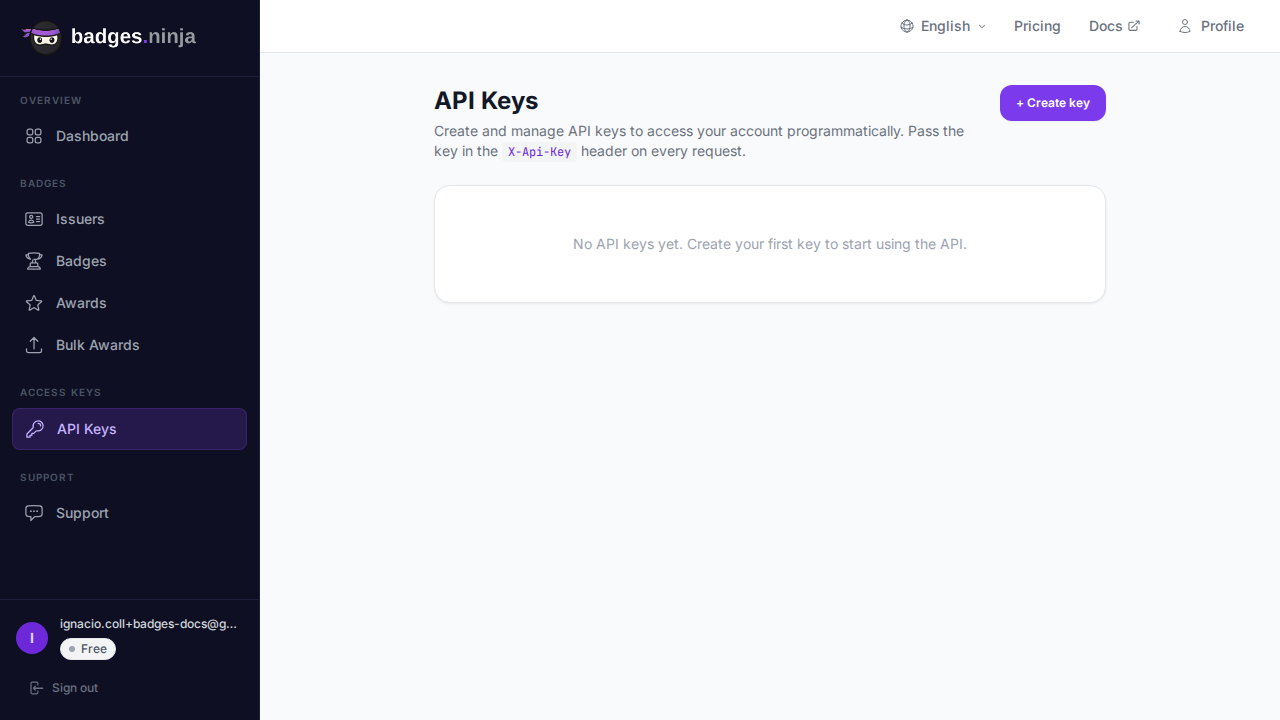
Badges Ninja’s API is intentionally small and REST-first. Two authentication modes cover almost every use case: a Cognito JWT (Authorization: Bearer <token>) for anything running inside the SPA, and an API key (X-Api-Key: bws_<32-hex>) for server-to-server calls. A minimal credential looks like this:
curl -X POST https://api.badges.ninja/awards \
  -H "X-Api-Key: bws_1a2b3c4d5e6f7a8b9c0d1e2f3a4b5c6d" \
  -H "Content-Type: application/json" \
  -d '{
    "badgeId": "bdg_9f8e7d6c",
    "recipient": {
      "name": "Jamie Rivera",
      "email": "trainee@example.com"
    },
    "issuedOn": "2026-07-16"
  }'
Or the same call in Python:
import requests
resp = requests.post(
    "https://api.badges.ninja/awards",
    headers={"X-Api-Key": "bws_1a2b3c4d5e6f7a8b9c0d1e2f3a4b5c6d"},
    json={
        "badgeId": "bdg_9f8e7d6c",
        "recipient": {
            "name": "Jamie Rivera",
            "email": "trainee@example.com",
        },
        "issuedOn": "2026-07-16",
    },
)
print(resp.json())
That single call returns the credential record, the unique verification URL, and a QR code reference — no separate call needed to “publish” or “activate” the credential. For teams triggering issuance from a webhook (course completion, form submission, purchase event), that’s one integration point instead of a multi-step handshake. Full request/response shapes are documented on the awards API reference and the authentication guide.
Analytics and reporting
Sertifier’s built-in dashboards are a genuine selling point if your team doesn’t want to build reporting: open rates, LinkedIn shares, and certificate views come out of the box. Credly’s analytics go further at the enterprise tier, with cohort- and organization-level rollups aimed at L&D leadership reporting up to executives.
Badges Ninja’s engagement stats live on each credential and each badge — views, verification-page hits, and share counts — plus email delivery tracking (open, click, and bounce on every recipient send), all visible from the dashboard without a separate reporting module to configure. It’s not a BI platform; it’s meant to answer “did anyone actually look at this credential” without wiring up an analytics stack first. The same CSV workflow that powers bulk issuance is covered in the walkthrough below.
Bulk issuance at cohort scale
If you’re issuing to a cohort rather than one recipient at a time, all three platforms support some form of batch upload. The practical difference shows up when something goes wrong mid-batch — a malformed email, a duplicate recipient, a network blip on row 340 of 1,200.
Credly and Sertifier both handle bulk CSV uploads, typically processed as a single job you re-run from scratch on failure. Badges Ninja’s bulk credentials flow tracks progress server-side, so you can pause a batch, close the browser, and resume later without re-issuing rows that already succeeded — useful when a “cohort” is actually 3,000 rows pulled from a registration system with a few dirty emails in the mix. The full walkthrough, with screenshots of the upload and progress screens, is in how to issue Open Badges from a CSV.
Where Sertifier and Credly actually win
Being straight about tradeoffs: if your program needs deep HRIS/LMS integrations, dedicated account management, or you’re issuing credentials at a scale where a procurement team is going to review the contract anyway, Credly’s enterprise machinery is purpose-built for that, and the brand recognition among recipients is real. Sertifier’s middle-tier hosted email delivery and built-in analytics dashboards are also genuinely useful if you don’t want to build reporting yourself and your volume fits their published tiers.
Neither of those strengths disappears just because a cheaper option exists. They’re the right call for a specific kind of buyer — mainly larger, integration-heavy programs with budget and time for a sales cycle.
Where the free/$9 option wins
If you’re a training team, bootcamp, conference organizer, or association issuing anywhere from a handful to a few thousand credentials a year, and you don’t want to sit through a sales call to find out what it costs, that’s the gap Badges Ninja fills. You get:
- A visual designer with real creative control, not a template picker
- Bulk issuance via CSV for cohort-sized credentials — see how to issue Open Badges from a CSV for the walkthrough
- A REST API (
https://api.badges.ninja) for programmatic issuance if you want to trigger badges from a webhook or LMS completion event - A recipient portal and public profile, so earned credentials don’t just live in an inbox
- Pricing you can see before you sign up
Decision guide
- Large enterprise, deep integrations, dedicated CSM needed → Credly.
- Mid-size program, want hosted email + analytics, comfortable with a contact-sales step at volume → Sertifier.
- Small-to-mid program, want design control and transparent pricing, don’t want a sales call → Badges Ninja.
For a deeper look at Sertifier specifically, see the Sertifier alternative comparison; for the Credly-specific breakdown, see the Credly alternative comparison. Both cover migration paths in more detail than fits here — including how Badges Ninja accepts legacy Open Badge IDs so existing recipient records keep working if you switch.
Ready to issue your first verifiable credential? Start free at badges.ninja — visual designer, public verification page, PDF certificate, Open Badge v2.0 output. No credit card required.
About the author
Nacho Coll
Founder & Engineer at Badges Ninja
Nacho founded Badges Ninja to make issuing verifiable digital credentials as simple as a single API call — Open Badge v2.0 badges and certificates, minted, hosted, and verifiable without standing up your own issuer infrastructure. Writes about the Open Badges spec, credential verification, and running a credentialing platform serverless on AWS, from the operator side of the wire.